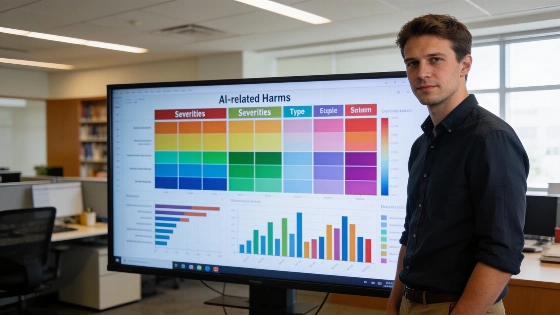
Automated systems increasingly shape how organizations evaluate the risks and consequences tied to artificial intelligence. The Massachusetts Institute of Technology (MIT) AI Risk Initiative has rolled out an updated framework for its AI Incident Tracker, classifying more than 1,500 reported incidents by harm type and severity. This method gives educators, researchers, and policymakers a sharper look at how AI-related harms are reported and assessed.
How the AI Incident Tracker Works
The AI Incident Tracker, built by the MIT AI Risk Initiative, relies on the AI Incident Database from the Responsible AI Collaborative. The database defines an incident as "an alleged harm or near harm event to people, property, or the environment where an AI system is implicated," setting apart actual or near-actual events from hypothetical risks. The tracker uses 13 harm categories, with ten based on the Center for Security and Emerging Technology’s (CSET) AI Harm Taxonomy. Three additional categories—psychological harm, epistemic harm, and child sexual exploitation and abuse—broaden the framework to cover issues relevant to education and information integrity. The system uses a language-model pipeline to assign ratings from incident descriptions gathered from news reports. This enables consistent classification at scale, but it also means the tracker reflects the focus and limits of public reporting.
Understanding Harm Categories and Severity Levels
Each reported incident falls into one or more harm categories and receives a severity rating. The five severity levels—Negligible, Minor, Substantial, Severe, and Catastrophic—are defined by the type of harm. For financial loss, the system uses monetary thresholds. Other categories consider how many people are affected or how lasting the damage is. The tracker draws on 1,785 incidents in the AI Incident Database, a higher total than the "more than 1,500" figure previously cited. Across all harm-category ratings, there are about 2,900 minor ratings, 540 substantial ratings, 156 severe ratings, and four catastrophic ratings. Minor ratings make up roughly 81% of non-negligible ratings, substantial account for 15%, severe for 4%, and catastrophic for 0.1%. These totals reflect ratings across categories, since a single incident may be classified under multiple harm types.
The epistemic harm category, which covers damage to knowledge and information such as fabricated citations, false claims, and loss of trust in expertise, recorded 701 minor ratings, 26 substantial, and 29 severe. Psychological harm, including temporary distress and more serious emotional impacts, saw 346 minor ratings, 17 substantial, and two severe. Privacy-related incidents included 95 rated as substantial and 41 as severe. In the child sexual exploitation and abuse category, 61 incidents were classified as substantial and six as severe. All four catastrophic ratings in the dataset concern financial loss or property damage. No catastrophic ratings were assigned to physical harm, psychological harm, democratic norms, environmental harm, or human-rights harm. The tracker’s methodology and these patterns have been discussed in analyses such as "Dose, Not Disaster: Why AI Safety Law Is Measuring the Wrong Thing."
Implications for AI Literacy and Responsible Use
For educators and students, the expanded taxonomy draws attention to the need to understand not only direct physical or financial harms but also less visible risks like epistemic and psychological impacts. Epistemic harm is especially relevant to academic integrity and the reliability of AI-generated information, with examples including hallucinated citations and confident medical errors. The tracker’s methodology notes that automated classifications depend on the quality and detail of submitted reports, and voluntary reporting introduces sampling bias. Ratings are assigned by a language model working from news reports, inheriting both the press’s focus and its errors. The tracker is being used in policy debates to push for more attention to recurring, lower-severity harms instead of focusing only on catastrophic scenarios.
Limitations and Future Directions
The AI Incident Tracker rates individual incidents and does not capture diffuse harms that build up across many events, such as labor displacement. The main limitation is methodological: the tracker applies automated classification to a non-random, news-derived incident corpus, which can reproduce press-selection bias and incomplete incident descriptions. The AI Incident Database and the OECD AI Incidents Monitor use different definitions and collection methods, so direct numerical comparisons are unreliable. For example, the AI Incident Database recorded 362 incidents in 2025, up from 233 in 2024, an increase of about 55%. This rise may reflect several factors, including expanded AI adoption and greater media coverage. The tracker is best used as an analytical and research tool, not as an official regulatory register, and is being discussed in the context of AI-safety law and policy debates. For educators and AI literacy advocates, the tracker provides a practical resource for understanding the range of AI-related risks and the need for critical evaluation when using AI in learning and research environments.