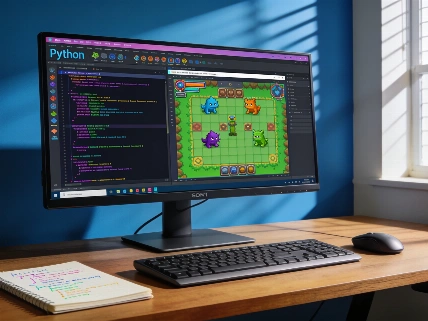
Developing intelligent tools such as chatbots, voice assistants, and recommendation engines depends on more than just algorithms. The programming language you choose affects how fast you can test ideas, tap into advanced libraries, and turn concepts into working AI systems. Python has become a leading option for AI work because of its straightforward syntax, broad library support, and adaptability across fields. The Python Software Foundation describes Python as powerful, portable, open source, and easy to learn. This reputation helps explain its ongoing influence in AI and scientific computing. Dean Wampler, featured on Python.org, points out that "Python’s convenience has made it the most popular language for machine learning and artificial intelligence."
Why Python Is a Preferred Language for AI
Python attracts developers working in AI because it makes getting started less daunting. Its readable syntax lets newcomers focus on solving problems instead of wrestling with language details. Python’s flexibility supports web development, automation, data analysis, and scientific computing, which broadens the range of tech jobs available. Its ability to run on different operating systems and its open-source license encourage both commercial use and redistribution, building a worldwide network of learners and professionals.
Python’s library ecosystem is a major asset. Instead of reinventing the wheel, developers can use proven tools for machine learning, deep learning, data processing, and language tasks. Libraries such as TensorFlow, PyTorch, Scikit-learn, NumPy, Pandas, OpenCV, NLTK, spaCy, Keras, and Hugging Face Transformers offer ready-made components for AI projects. This speeds up development and makes advanced AI methods available to both beginners and experienced engineers. The Python Package Index (PyPI) lists thousands of third-party modules, serving as a central resource for distributing and finding the tools used in Python-based data, scientific, and AI projects. For more on packaging and distributing Python projects, see the official Python Packaging User Guide.
Core AI Applications Built with Python
Python plays a role at every step of AI development, from gathering and cleaning data to training models and deploying them. In machine learning, Python supports predictive models for sales forecasting, spam filtering, fraud analysis, product recommendations, and customer behavior insights. Libraries like TensorFlow, PyTorch, and Scikit-learn are central to these processes.
Deep learning, which uses neural networks to handle complex data such as images and speech, also relies on Python. Frameworks including TensorFlow, PyTorch, and Keras help developers build and train models for face recognition, speech analysis, and language understanding.
Python stands out in natural language processing (NLP) as well. With libraries like NLTK, spaCy, and Hugging Face Transformers, developers can create chatbots, sentiment analysis tools, language translators, text summarizers, and speech-to-text systems. These tools let businesses process customer feedback and automate support while handling large volumes of text data.
Computer vision projects—like facial recognition, medical image analysis, object detection, and self-driving vehicle systems—often use Python with OpenCV and deep learning frameworks. Generative AI, which produces new content such as text, images, or code, also depends on Python to connect applications to AI models and build smart workflows.
Python Libraries That Power AI
Python’s library ecosystem gives it a clear edge for AI work. Here are some widely used libraries and their main roles:
- TensorFlow: Machine learning and deep learning
- PyTorch: Neural networks and AI model development
- Scikit-learn: Traditional machine learning
- NumPy: Numerical calculations and array operations
- Pandas: Data cleaning and analysis
- OpenCV: Image processing and computer vision
- NLTK: Natural language processing
- spaCy: Advanced text processing
- Keras: Building and training neural networks
- Hugging Face Transformers: Working with modern AI language and vision models
Newcomers do not have to learn every library immediately. A practical approach is to start with Python basics, NumPy, Pandas, and Scikit-learn before moving on to advanced frameworks. The Python Packaging Authority points out that there is no single required build backend for packaging Python projects and suggests choosing tools based on project needs, since the ecosystem supports a range of users.
Real-World Uses of Python and AI
AI solutions built with Python are changing how industries operate. In healthcare, AI models review medical images and process patient records. Banking and finance use AI for fraud detection, risk analysis, and automating customer service. E-commerce platforms depend on recommendation systems to tailor shopping experiences. Education technology applies AI to suggest learning materials and automate grading. Transportation companies use computer vision and machine learning for traffic forecasting and route planning. Digital marketing teams turn to Python for campaign analysis and customer feedback, helping guide business choices.
Python’s reach in AI covers large-scale, multilingual, and networked projects. For instance, job postings on Python.org mention work such as building relevance benchmarks for channel search in six or more languages, analyzing networks across three million public Telegram channels, and measuring Telegram and MTProto proxy reachability by country. These examples show Python’s use in multilingual search, large-scale data analysis, and network research, highlighting the range of AI work that Python skills can support.
Learning Python for AI: A Step-by-Step Path
For beginners, following a structured learning path builds both confidence and practical ability:
- Start with Python basics: variables, data types, operators, conditionals, loops, and functions.
- Learn core data structures: lists, tuples, dictionaries, sets, strings, and file handling.
- Practice with NumPy and Pandas for numerical work and data analysis.
- Build a foundation in math and statistics: probability, averages, standard deviation, and basic linear algebra.
- Explore machine learning basics using Scikit-learn: linear regression, decision trees, and classification.
- Develop small projects such as a spam classifier, recommendation system, or chatbot.
- Move on to frameworks like TensorFlow, PyTorch, and Hugging Face Transformers as your skills grow.
Regular practice and hands-on projects matter more than trying to learn every tool at once. For a closer look at Python’s syntax and structure, see the Python indentation guide for beginners.
Career Opportunities with Python and AI Skills
Companies looking for AI solutions need people with programming, data, and machine learning skills. Roles include Python developer, machine learning engineer, data analyst, AI engineer, and data scientist. Each job calls for a different mix of programming, math, statistics, and hands-on project work. Python’s flexibility means learning it can lead to many tech careers, from software development to data analysis and automation. Python’s open-source license, managed by the Python Software Foundation, allows for commercial use and redistribution, supporting both individual learners and organizations worldwide. The language is widely used in scientific and numeric computing and in AI model development workflows.
Getting Started with Python and AI
Start by learning Python basics and gradually move into data analysis and machine learning. Use practical projects to build your understanding. As you advance, try out more complex AI libraries and frameworks. If you want structured learning, look for local programming courses that focus on hands-on work and real-world projects. For more on Python’s features and community, visit the official Python website.