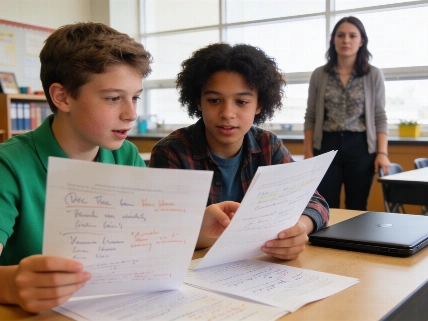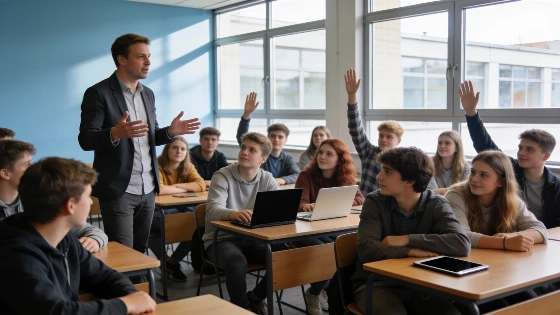
Across Europe, teenagers have already brought artificial intelligence into their homework routines, but many still have not received formal instruction on responsible use or how to check AI-generated answers. ThinkYoung’s research found that 79% of surveyed teenagers used AI for school assignments, while only 47% had been shown how to do so by a teacher.
AI Use Outpaces Classroom Guidance
OpenAI’s Responsible AI in Education report, based on partnerships in Estonia, Slovakia, Greece, and Italy, points to a growing gap between how quickly students adopt AI and the support they get in schools. The report urges governments and educational institutions to focus on teacher training and set clear classroom policies for AI. OpenAI’s country accounts describe time savings, student frustrations, and ongoing questions about whether AI is actually improving learning outcomes.
ThinkYoung’s survey included 5,000 secondary students aged 13 to 19 from Austria, Estonia, France, Germany, Greece, Italy, Poland, Spain, Sweden, and the UK, with responses gathered in spring 2026. Another survey covered 600 teachers from 10 countries, adding Kenya and the United Arab Emirates. Eight focus groups brought in views from 52 students, parents, and teachers.
The European Commission’s 2026 Education and Skills Package names rapid digital change, including artificial intelligence, as a systemic challenge for schools, along with declining basic skills and teacher shortages. The Commission says children need support from well-trained teachers to handle AI safely, tying AI readiness to professional development, school leadership, digital well-being, and parent cooperation. The policy response now treats student AI use as part of a wider school issue, and the Commission plans to launch an EU Network of Advisory and Support Services from 2027 to offer practical help on leadership, well-being, digital readiness, and AI readiness European Commission education package.
Students Seek Clearer Rules and AI Literacy
Among surveyed teenagers, 95% said they used AI tools in general. For schoolwork, students mainly turned to AI to clarify concepts or generate answers, and 26% admitted using it to complete assignments. Permission to use AI was often unclear: 43% said they had teacher approval the last time they used AI for schoolwork, 36% used it without permission, and 21% were unsure. Students without clear guidance were twice as likely to ask AI to do their work compared to those who received instruction—36% versus 18%. These numbers show associations in survey responses, not direct proof that guidance caused the difference.
While 75% of students said teachers discussed AI’s opportunities and challenges, only 35% had been shown how to spot bias or incorrect information. Student habits show more tension: 88% said they added their own thoughts to AI outputs, and 74% checked accuracy, but 49% admitted copying AI-generated answers for homework. ThinkYoung’s analysis found no significant effect from teacher permission or guidance on this copying. Students with a positive view of AI’s educational impact were more likely to report copying answers. One 15-year-old student in Belgium told researchers, “I think it’s important that you ask AI specifically how to do things, so AI does not just give you the answer.”
Many students want more support. Over half wanted teachers to explain when AI could be used for homework (55%) and help them judge the reliability of AI outputs (56%). Only 41% wanted teachers to use AI more in class. Younger students, aged 13 to 15, showed more uncertainty: 65% wanted clearer homework guidance, and only 45% felt confident judging AI accuracy, compared to 61% of 18- to 19-year-olds. Half of all respondents wanted to learn about AI’s risks at school, while 40% prioritized its possibilities and effects on society.
The European Commission announced in November 2026 that it will develop age-appropriate reference learning outcomes and assessment guidance for AI literacy, based on the EU-OECD AI Literacy Framework, and will pilot an AI Literacy Certificate for learners starting in the 2027/28 school year. The package also includes a proposed Council Recommendation on making the teaching profession more attractive, calling for stronger initial teacher education, ongoing professional development, and teacher agency in AI use. Revamped Teacher Academies 2.0 will target novice teachers and school leaders from 2027 Commission Skills Package details.
Teachers Balance Workload Relief and Concerns
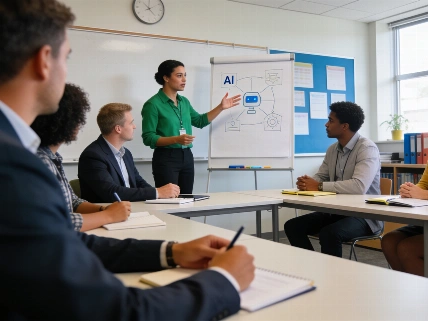
AI use is common among teachers as well. Eighty percent reported using AI for work or to manage workload, and 52% used it during lessons. Much of this use happened outside official school accounts, with 62% accessing AI through personal accounts. Teachers mainly used AI for lesson planning and creating classroom content. Sixty-five percent cited time savings as a main benefit, and 47% valued support for creative or engaging teaching. Only 14% named increased face-to-face interaction as a primary benefit, showing that AI’s main impact so far is on workload, not student attention.
Privacy and security were the most common barriers to wider AI use (48%), followed by a lack of clear school guidance (34%). Teachers asked for better tools for lesson planning and feedback, more accurate outputs, and products tailored to their curricula. While 85% agreed that AI helped students with additional learning needs, these are teacher perceptions, not independently measured improvements. The top concern was a possible loss of critical thinking, chosen by 58%, along with worries about reduced creativity, overreliance, and academic integrity.
The European Digital Education Hub’s “Educators in the Digital Era” initiative frames AI as part of a broader shift in teachers’ professional roles, stressing the need for educators to design technology-supported instruction, select digital resources, and judge when technology adds educational value. The initiative’s first summer school took place in Porto in August and September 2026, with more collaboration planned through January 2027. The program focuses on digital literacy, inclusion, engagement, and sustainable responses to new technologies such as AI. Practical support and resources for educators are being developed step by step, with the final format to be defined together European Digital Education Hub.
Country Programs and Policy Approaches
OpenAI’s report groups its partnership lessons around five priorities: educational goals, educator preparation, local expertise, critical AI literacy, and credible evidence. The company presents these as context-specific lessons, not a universal model. Estonia’s AI Leap program, for example, saw 794 of 828 teachers report professional AI use, with 723 estimating average weekly time savings of 1.8 hours. The ITI tutor, built on ChatGPT Edu, received an average satisfaction score of 3.07 out of five from 182 students, with feedback mentioning too many questions, slow exchanges, and a need for clearer explanations. These responses do not show whether learning outcomes improved.
Greece’s framework requires trained teacher oversight and bans fully automated assessment decisions and profiling. Slovakia’s approach involves the education ministry, universities, and technical partner Aricoma. Malta’s AIforAll program requires participants to complete two learning modules before getting a free premium AI subscription, with the first phase serving the wider population. OpenAI also calls for independent evaluations that can publish unfavorable findings without supplier veto. The University of Tartu and Stanford’s SCALE are developing a Learning Outcomes Measurement Suite to assess AI’s educational impact. OpenAI’s Learning Lab brings together education researchers to study when and how AI supports education systems, with research priorities covering knowledge, independent thinking, and retention.
Across Europe, responsible-AI training is becoming a practical professional-development topic for teachers. The European School Education Platform lists tutorials on copyright and responsible AI use, showing that classroom AI governance goes beyond accuracy and cheating concerns to include intellectual-property and fair-use questions. For example, a tutorial published in April 2026 covers what teachers need to know about copyright and responsible AI use. Professional development opportunities include Erasmus+ teacher-training courses, such as a five-day program in Ptuj, Slovenia, covering robotics, STEAM, coding, and AI in teaching, and a 25–30 hour course in Lisbon with a €400 participant fee, which covers lesson planning, educational-material creation, productivity, data protection, copyright, responsible use, and evaluation of educational value. These offerings show that while professional development exists, it is not yet universal or compulsory for all European teachers.
Recommendations for Responsible AI Use in Schools
ThinkYoung recommends that schools set age-appropriate rules for homework, revision, classroom activities, and assessments, with clear explanations of when AI is encouraged, restricted, or inappropriate. The organization also suggests building accuracy checks, bias recognition, and misinformation awareness into curricula, supported by subject-specific teacher training. Parents and carers should get practical resources explaining school expectations, privacy, and responsible use. For assessments where AI is allowed, students should document their initial aims, prompts, responses to AI-generated material, and final accuracy checks. Marking should recognize reasoning, application of concepts, and the quality of students’ critique along with the finished work.
According to George Osborne, Head of OpenAI for Countries, “Our ambition is for AI to strengthen what young people can understand, create and do for themselves, while giving teachers more time for thought, creativity and individual attention.”