Rolling out a new process in a global organization rarely ends with the final documentation. Teams in different countries often interpret instructions through their own habits, languages, and regulatory settings. Even with a clear standard, uneven training can push employees back to old routines or lead them to improvise, which hurts quality and compliance. The OECD points out that organizations may use the same process but differ widely in digital and cognitive skills. This makes it critical to assess workforce capabilities before launching uniform training modules. Tools like the OECD Education & Skills Online assessment help pinpoint individual training needs by tying results to international benchmarks in literacy, numeracy, and problem-solving in tech-heavy environments.
Why Standardization Is Essential—And Difficult
Standardized processes let organizations deliver steady quality, simplify compliance, and compare performance across regions. They also make onboarding easier, since new hires can learn one approved method. But these gains only show up when employees actually grasp and use the new process. Training global teams gets complicated by language gaps, cultural differences, local rules, and different software tools. A single training module rarely fits all these realities. The OECD reports that digital-skills gaps, from basic to advanced, can limit how people and firms use digital tools productively. In Colombia, for example, employers describe digital skill levels as lower than regional averages (OECD Economic Surveys: Colombia 2026).
Distinguishing Core Steps From Local Adaptations
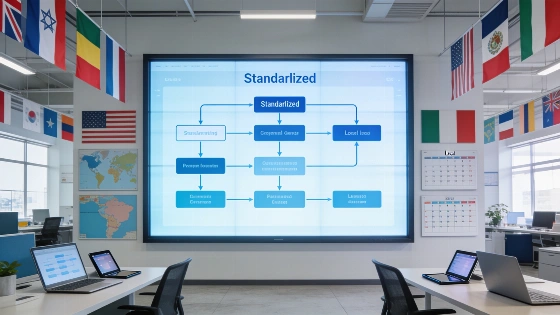
One practical move is to separate the core of a process from parts that can be adapted locally. The core covers essential steps, approvals, controls, and data standards that must stay the same everywhere. Local adaptations might involve language, regulatory needs, or specific software setups. Training should spell out this difference, so employees know which parts are fixed and which can be adjusted for their context. A useful approach is to deliver a global core module for everyone, then add short local modules in the right language, using examples that match regional realities. The OECD notes that governments help define training standards and credentials, while local instruction can be shaped to fit fast-changing digital environments.
Making the Case for Change
Employees tend to accept a new process when they see its purpose. Training should explain why standardization matters in terms that connect with each group. For frontline staff, it could mean clearer instructions and fewer mistakes. For managers, it might be about fairer performance comparisons. For customers, the focus is on steady service. Bringing in respected local leaders or experienced employees to share these reasons can make the message more believable than a top-down directive. The OECD's approach to workforce training stresses using diagnostic data to spot needs before rolling out a global curriculum, backing the idea that change works better when it targets real local gaps.
Reducing Friction in Learning
Switching to a new process is rarely smooth. Employees have to unlearn old habits and pick up new ones, often under time pressure. Common hurdles include unclear first steps, too much information, unfamiliar terms, and a lack of support when questions come up. Learning and development teams can help by breaking the process into manageable stages, offering in-app guidance, creating quick-reference job aids, and keeping terminology consistent across all materials. Support channels should be open so employees can get help during the transition. The OECD describes efforts like Hungary’s National Tax and Customs Administration’s Digital Competence Compass, which maps digital and data skills across the workforce to guide targeted development (OECD Tax Administration 2026).
Integrating AI Into Standardized Workflows
As organizations bring AI tools into daily work, process standardization must cover how these technologies are used. Some teams use approved AI tools within set guidelines, while others try public AI services, sometimes risking data security. Training should make clear which AI tools are approved, where they fit in the process, and what data rules apply. This helps avoid uneven practices and cuts risk. Teams may also adopt AI-enabled processes at different speeds, so ongoing support and clarification matter. The OECD notes that the AI workforce’s share of employment has nearly tripled in less than a decade, but AI-skill shortages still block progress and differ widely across countries and genders (OECD Trends Shaping Education 2025). This shows the need for tailored training approaches.
Flexible Delivery for Global Teams
Global audiences get more from a mix of learning formats. Self-paced digital modules let employees learn across time zones. Short videos with subtitles or local voiceovers make content easier to access. Live virtual sessions, ideally led by local facilitators, give space for interaction. Training regional champions first lets them support colleagues and answer questions. In-app guidance and communities of practice reinforce learning as employees use the process in real work. This blended approach delivers core content consistently, while local support meets specific needs. The OECD highlights the need for ongoing digital culture development and investment in workforce digital skills. In Eastern Partnership economies, digital-literacy policies are still growing, and targeted, locally accessible training—like Java fundamentals courses—are being delivered through partnerships with groups such as Tekwill Academy and Oracle.
Reinforcing New Processes Over Time
Initial training is just the start. Without reinforcement, employees may fall back into old habits, especially under pressure. Learning and development teams should plan follow-up refreshers, provide job aids and checklists at the point of need, and gather feedback from managers and local champions about ongoing issues. Reviewing error reports and audit findings can show which steps need more explanation or practice. Learning materials should be updated whenever the standardized process changes, so support stays relevant. The OECD’s Education & Skills Online program backs ongoing assessment by giving individual-level results tied to international skills measures, letting organizations track progress and adjust training as needed.
The Role of Local Champions
Local champions—trusted employees who learn the new process early—help bridge the gap between global standards and local realities. They adapt training for their region, answer colleagues’ questions, collect feedback, and model the new way of working. Their insights can shape future improvements to both the process and the training approach. This strategy appears in earlier guidance on scaling field training while keeping expertise. The OECD also points out that flexible, coordinated, and aligned training systems are key for adapting to changing technology and local needs.
Measuring Progress and Avoiding Pitfalls
To see if process consistency is improving, organizations can track compliance rates, error and rework rates, cycle time variation, audit findings, employee confidence, and use of approved tools—including AI. Comparing these indicators across regions helps spot where more support is needed. Common pitfalls include forcing changes without listening to local teams, translating content without real localization, skipping reinforcement, ignoring valid local differences, and missing AI use in the standard process. The OECD’s reporting on government transformation in Australia describes using workforce analytics, job-family frameworks, and labor-market data to spot occupations likely to decline, map transferable skills to growing roles, and design targeted reskilling pathways. This shows the value of data-led, targeted approaches to workforce development.
Getting Started With Global Process Training
- Identify a high-impact process that varies across regions.
- Define core and local elements with input from regional teams.
- Train regional champions first.
- Launch a global core module plus local modules.
- Measure consistency and refine the approach based on results.