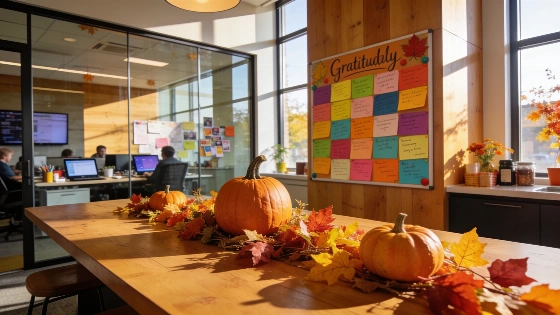
Thanksgiving season often prompts organizations to gather their teams, but the most impact comes from activities that move past surface-level games or routine gratitude lists. When planned with purpose, Thanksgiving team-building can prompt employees to think about their experiences, call out each other's efforts, and pass along useful knowledge that lifts the whole workplace. Fernando Olivera and Susan G. Straus found in their research that group interaction boosts individual learning. Participants who joined or watched group work performed better on later solo tasks than those who worked alone (peer-reviewed study).
Why Thanksgiving Is a Unique Opportunity for Team Learning
Thanksgiving-themed activities can fill more than one role. Some teams lean into light games or friendly contests, while others use the season to focus on peer recognition, reflection, and knowledge sharing. For learning and development (L&D) professionals, these moments help reinforce habits that keep learning active all year. Linking gratitude with learning—by having employees share what they picked up from a colleague—can spotlight informal mentors and spark peer learning that might otherwise stay hidden. Amy C. Edmondson's work on psychological safety shows a strong tie between team learning behaviors and environments where people feel safe sharing lessons and giving credit (Harvard Business School research).
Types of Thanksgiving Team-Building Activities
Thanksgiving team-building can take several forms, each with its own focus. Some activities are built for fun and relaxation, like trivia contests or scavenger hunts. Others center on connection and appreciation, such as team storytelling or volunteering. Another approach uses the holiday as a prompt for employees to reflect on growth, share expertise, and spot future development needs. The best activities blend fun with clear learning or team goals, so the benefits stick around after the event. A study of 580 employees in high-tech companies found that team collaboration, information sharing, and balanced participation all drive innovative performance, with communication behavior as a key link.
Choosing the Right Activity for Your Team
Leaders should clarify their goals before picking an activity. Do they want to spark reflection, boost peer recognition, improve knowledge sharing, or spot future development needs? Time limits, team setup (onsite, hybrid, or remote), and whether the activity is live or asynchronous all shape the best choice. Planning for what comes after—like how to capture and use shared insights—helps the impact last. Research with 139 teams in the U.S. Department of Veterans Affairs found that higher-performing teams, as measured by the Executive Team Assessment, reported more engagement, stronger psychological safety, and more supportive learning environments.
Fifteen Thanksgiving Team-Building Ideas
- The Learning Harvest: Employees sort recent experiences into Harvest (meaningful results), Compost (what to stop or rethink), and Seeds (what to develop next), then discuss as a group.
- What I Learned From You: Each participant calls out a colleague by sharing a specific lesson learned from them during the year.
- The Knowledge Potluck: Employees add a useful resource or tip, like a template or checklist, to a shared collection.
- Teach Me In Five: Team members teach a practical skill or technique in five minutes.
- The Skills Gratitude Map: Visualize who helped with key achievements and what skills they brought, revealing informal mentors and experts.
- Create a Team Learning Recipe: Use a recipe format to describe why a project worked, including ingredients, method, and lessons for next time.
- Lessons From Our Mistakes: Share setbacks and what was learned, focusing on growth over blame.
- Build a Year-In-Learning Timeline: Map out important learning moments from the past year and discuss their meaning.
- The Thanksgiving Problem-Solving Challenge: Teams tackle a real workplace problem with constraints, then reflect as a group.
- Peer Coaching Pairs: Pair up to discuss strengths, development goals, and support needs.
- The Gratitude-To-Growth Exercise: Complete statements about gratitude for past learning and spot areas for future growth.
- A Thanksgiving Microlearning Challenge: Run a short, asynchronous challenge with daily activities like recognizing colleagues, reflecting on lessons, and sharing resources.
- Virtual Learning Bingo: Use bingo cards with prompts tied to learning and collaboration for remote teams.
- An AI-Assisted Knowledge Harvest: Use AI tools to organize shared lessons into themes, following organizational AI policies.
- Give Back and Learn: Join volunteering or community service, then reflect on skills used and teamwork.
Making Activities Inclusive and Meaningful
Thanksgiving team-building should always be optional and open to all. Activities need to avoid assumptions about cultural meaning and focus on broad themes like reflection and appreciation. Making sure everyone can join in—onsite, hybrid, or remote—lets the whole team benefit. Research on psychological safety points to the value of voluntary, respectful information sharing, since forced disclosure exercises may not deliver the same positive results for learning and inclusion.
Supporting a Culture of Learning
Well-planned team-building activities help organizations build habits of reflection, knowledge sharing, and peer recognition that last past the holiday. The strongest evidence supports group collaboration, information sharing, balanced participation, recognition, and reflection. For more ways to turn expertise into organizational assets, see this practical guide. For further ideas, visit eLearning Industry's Thanksgiving team-building activities.