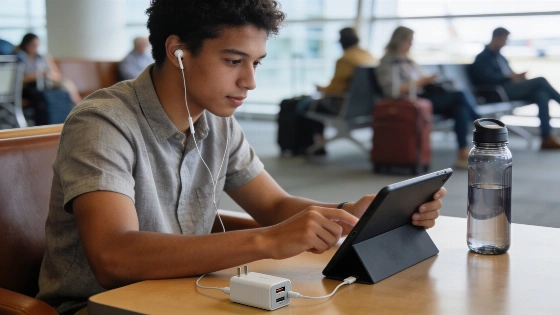
Studying, teaching, or pursuing professional development on the road means adjusting to unfamiliar settings while still needing reliable digital tools. Students heading to conferences, educators running workshops, and independent learners exploring new destinations all benefit from technology that keeps them productive and connected.
Portable Devices for Learning and Productivity
Lightweight tablets like the iPad give travelers a flexible way to read, take notes, join video calls, and use educational apps. These devices also help with tasks such as taking photos, booking restaurants, and checking hotel reviews, so users can handle both learning and travel logistics. E-readers such as the Kindle let travelers carry a full library in a slim device, with sharp displays for comfortable reading and waterproofing for poolside study. Some Kindle models carry an IPX8 water-resistance rating, which Amazon says means they can handle immersion in up to 2 meters of fresh water for 60 minutes (see technical specifications). This rating is specific to certain models and does not cover dust, salt water, or chemical exposure. Charging is straightforward with a USB-C cable, and a full charge takes about four hours from a computer or two hours with a 9-watt USB adapter (Amazon technical details).
Staying Connected and Powered Up
Access to internet and power is vital for digital learning away from home. A universal travel adapter with multiple USB ports keeps laptops, tablets, and phones charged in different regions. Portable chargers from brands like Anker provide backup power for smartphones and tablets, which matters when digital documents or vaccination records are needed on the go. Travelers who want to stream educational content or entertainment can use a Google Chromecast to cast media from their own devices to hotel TVs, making it easier to access familiar resources.
Air travel brings rules for lithium batteries and power banks. U.S. hazardous-materials regulations, detailed by the Department of Transportation and Pipeline and Hazardous Materials Safety Administration, require that consumer electronics with lithium-ion or lithium-metal batteries follow 49 CFR § 173.185 and related provisions. The Federal Aviation Administration and Transportation Security Administration set further restrictions, and airlines may add their own. Portable power banks count as spare lithium batteries and must go in carry-on bags, not checked luggage, with terminals protected from short circuits. The usual limit for easy carriage is 100 watt-hours, and larger batteries may need airline approval. Travelers should check device watt-hour ratings, calculated as milliamp-hours times voltage divided by 1000. Guidance also states that spare batteries must be removed from any bag that is gate-checked, and airlines may cap the number of power banks per passenger (Engadget travel guidance; Travel Card Charger, FAA rules).
Comfort and Well-Being During Travel
Long trips can take a toll, so comfort-focused gadgets help learners and educators stay refreshed. A neck massager that doubles as a travel pillow offers relief on flights or trains, with options like heat mode and longer battery life. For those who stick to familiar routines, a radio alarm clock with a digital display and snooze button provides a way to manage schedules without relying on a phone.
Organization and Security for Personal Items
Managing luggage and personal items is a frequent concern. Bluetooth item finders such as Tile Pro pair with a mobile app to help users locate misplaced bags or devices within a set range. A luggage scale is a straightforward tool for avoiding overweight baggage fees, especially when returning with new materials or souvenirs from educational trips.
Hydration and Sustainability
Clean water access is key for health and focus. Self-cleaning bottles like the Larq use UV-C LED technology to cut down on bio-contaminants, offering a reusable alternative to single-use plastic bottles. This is especially helpful in places where tap water quality is uncertain.
Audio and Entertainment Tools
Noise-canceling earbuds and portable Bluetooth speakers from brands like Bang & Olufsen support focused study, language practice, or downtime with music. Wireless earphones are compact and work well in transit or shared spaces, while portable speakers can boost group activities or presentations.
Wearable Technology for Active Lifestyles
Wearables such as the Apple Watch give travelers hands-free access to messages, emails, and fitness tracking. Heart rate monitoring and GPS features help maintain healthy routines and navigate new locations.
Selecting travel gadgets comes down to learning goals, destination, and personal habits. Each tool here meets a specific need, from digital access and comfort to organization and sustainability, helping learners and educators pursue knowledge beyond the classroom.