Running 2 million bank transactions through 54 validation rules puts any programming language to the test. In a recent benchmark, Kil-C handled this workload in 0.11 seconds, setting a fast pace for business-focused scenarios. The same task ran in Python, Go, Java, JavaScript, and pandas, with each language required to match output for a fair comparison. The Kil-C Team reports that all languages produced identical results across five business jobs—bank, events, logs, sales, and invoices—with Kil-C finishing first in each listed case.
Benchmark Results Across Languages
The test tracked how long each language took to process the transactions. Kil-C led at 0.11 seconds. Go followed at 1.14 seconds, Java at 2.21 seconds, JavaScript at 3.59 seconds, Python at 3.68 seconds, and pandas at 5.09 seconds. This puts Kil-C at 33 times the speed of Python for this workload, with outputs matching exactly. For the bank workload, the Kil-C Team reported 112 milliseconds for Kil-C, 151 milliseconds for Rust, 1.14 seconds for Go, and 3.68 seconds for Python. For other business jobs, Kil-C posted 379 ms (events), 244 ms (logs), 384 ms (sales), and 60 ms (invoices). Rust's times were 511 ms, 325 ms, 445 ms, and 84 ms for those jobs. Go's times ranged from 0.100 to 2.00 seconds, and Python's from 0.630 to 7.14 seconds.
Rust and Kil-C Head-to-Head
Rust is known for its speed, but in this benchmark, Kil-C finished the job in 112 milliseconds while Rust took 151 milliseconds. Out of 16 test programs comparing Kil-C and Rust, Kil-C was faster in 11, matched in 4, and slower in 1. The full set of results, including the one where Kil-C lagged, is published for transparency. The Kil-C Team also states that Kil-C used less memory than Rust on every business job in its comparison and used less or the same amount of energy as Rust on all 16 programs tested.
Testing Methodology and Transparency
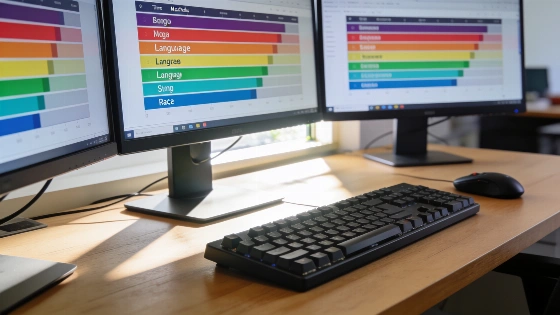
All languages ran the same business logic and dataset. Kil-C, Rust, Go, and Python were measured on November 25, 2026. Java, JavaScript, and pandas were measured on November 13, 2026. Each timing is the median of repeated runs to keep results consistent. The real-time race is available as a video, showing progress bars for each language as they process transactions without speedup. The Kil-C Team says every test is available in full at kilc.dev/#tests, including memory and energy comparisons, startup measurements, and a spreadsheet product called Gridline.
Benchmarking in Context
Kil-C positions itself as a new programming language and development platform aimed at business workloads, with performance, memory use, and energy consumption as core claims. The project reports performance gains from 5× to 144× over Python on "real business jobs." The workloads are labeled to reflect recurring business-data processing, not synthetic arithmetic kernels. However, established benchmark methodology, such as the Kotlin Benchmark methodology, highlights reproducibility, workload provenance, and environment control as key for comparing programming systems. Benchmarking research also separates synthetic benchmarks from workloads that mirror real production behavior, as discussed in a USENIX FAST12 poster on replayable workload models.
Where to Watch and Learn More
The main video focuses on the bank transaction race, while a longer 36-second version on the official site covers the Rust comparison, as well as energy and memory usage. For those interested in technical details and the full test suite, the site provides access to every benchmark and result. Readers looking to understand how Python's threading changes can affect performance in similar scenarios may find the earlier breakdown useful for more context. More details and the full set of results are available at the official Kil-C benchmark post.