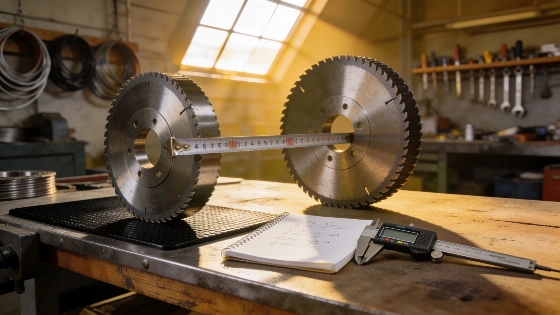
Getting the right replacement band saw blade involves more than just checking the distance between wheels. The actual length depends on both wheel diameters and the center-to-center distance. A small correction term can mean the difference between a blade that fits and one that is either too loose or too tight.
The Complete Band Saw Blade Formula
For two wheels with diameters D and d, and a center distance C (all in the same unit), the closed blade length L is calculated as:
L = 2 * C + math.pi * (D + d) / 2 + (D - d) ** 2 / (4 * C)
The first term, 2 * C, covers the straight spans between wheels. The second term, math.pi * (D + d) / 2, accounts for the blade wrapping around both wheels. The third term, (D - d) ** 2 / (4 * C), adjusts for wheels of different sizes. When the wheels are not the same, the blade's tangents do not run parallel to the center line. If both wheels match in size, this correction drops out, and the formula becomes L = 2 * C + math.pi * D.
This formula is standard in mechanical design and applies to both band saw blades and open flat belts on two pulleys. The terms represent the two straight runs, the combined half-circumferences, and a correction for different wheel diameters. The correction term comes from tangent geometry as an engineering approximation. For machines with a big difference in wheel diameters or a short center distance, a more precise geometric formula using the tangent angle may be needed. In most workshop and educational settings, the standard formula gives a practical and reliable estimate. For more technical details, see FireCAD Calc's belt length guide.
Python Implementation
The following Python function calculates the blade length and works for both equal and unequal wheel diameters:
import math

def blade_length(C: float, D: float, d: float | None = None) -> float:
    """Closed belt/blade length for two wheels.
    C -- center distance, D -- larger wheel diameter, d -- smaller wheel diameter (defaults to D).
    All values in the same unit.
    """
    if d is None:
        d = D
    if C <= 0 or D <= 0 or d <= 0:
        raise ValueError("dimensions must be positive")
    return 2 * C + math.pi * (D + d) / 2 + (D - d) ** 2 / (4 * C)
This function checks that all dimensions are positive and defaults to equal wheel diameters if d is not specified. The calculation works for both metric and imperial units, but all inputs must use the same unit system. The formula appears in industrial sizing guides, sometimes using 1.57 as a rounded value for math.pi / 2. Using math.pi in code gives greater precision.
Testing the Function
To check accuracy, use these test cases based on worked examples:
def test_equal_wheels_mm():
    assert round(blade_length(620, 400), 2) == 2496.64

def test_equal_wheels_inches():
    assert round(blade_length(25, 14), 2) == 93.98

def test_unequal_wheels():
    assert round(blade_length(750, 500, 400), 2) == 2917.05
For the unequal wheel example (C = 750, D = 500, d = 400), the correction term is just 3.33 mm. Using the equal-wheel formula with the larger wheel would make the blade about 154 mm too long. This shows why the third term matters. Such subtle errors are exactly what a targeted test can reveal, as discussed in our earlier breakdown of Python function testing.
Practical Measurement Tips
- Measure the center distance C with the tensioner set to mid-travel. Any change in C shifts the blade length by about twice that amount. The tensioner's range sets your tolerance. Manufacturer manuals, such as those from Baileigh Industrial, recommend measuring with the upper pulley midway through its adjustment range to match the calculated length to the machine's tensioning setup. See Baileigh Industrial's technical data for more details.
- Take wheel diameter measurements on the running surface, including any tires.
- Stick to one unit system—mixing millimeters and inches will produce incorrect results.
- Blades are sold in standard lengths, so round your calculated value to the nearest available size that allows for tension adjustment in both directions.
- Blade length is ultimately determined by the machine design and should be taken from the manufacturer's manual or the marking on the existing welded loop whenever possible. If no manual is available, measure around the wheels with the tensioner in its middle position or use an unstretched replacement loop.
- Band saw blades are specified by two dimensions: width and thickness (gauge), plus loop length. The wheel center distance and the travel of the tensioning mechanism determine the loop length, while wheel and guide assemblies constrain the usable width and thickness. Blades differing by only a few millimeters may sometimes be interchangeable, but only if the available tensioning travel is sufficient.
This formula and function also work for flat belts on two pulleys, making it a versatile tool for workshop calculations. The original formula is sourced from Metal-Cutting Band Saw Blades (publisher — Stankotorg). For more context on the geometric assumptions and limits of this calculation, see the Virtual Tools bandsaw blade calculator.