Unexpected contradictions in printable escape room puzzles can disrupt a group activity before it starts. While designing tabletop mysteries for KitFlow Studio, two persistent challenges appeared: clue chains that allow more than one interpretation and single-track booklets that let one participant take over the session. These issues frustrate teams and weaken the collaborative aspect. The escape room industry has expanded quickly, with a 2018 directory listing 5,740 registered facilities in 117 countries, and 72% of surveyed businesses opening between 2015 and 2017, as reported by Moravian Geographical Reports. This growth has pushed for more reliable and repeatable puzzle design approaches.
Mathematical Verification with Python's Z3 Solver
To avoid ambiguous or conflicting clues, each puzzle can be modeled as a set of logical constraints using the z3-solver library in Python. Z3, created by Microsoft Research, is an SMT (Satisfiability Modulo Theories) solver that decides logical formulas over combinations of theories like arithmetic, bit-vectors, arrays, and uninterpreted functions. This makes it a fit for escape-room logic involving timestamps, numeric codes, ordering, and Boolean relationships. The main Z3 paper, "Z3: An Efficient SMT Solver," describes the system as a free solver for general logical problems (Springer Nature).
Take the mystery The Midnight Server Audit as an example: each evidence sheet is a group of constraints. Before making printable PDFs, a verification script checks two main properties:
- Uniqueness: There must be one solution that fits all clues.
- Non-redundancy: If any single clue is removed, multiple solutions should become possible, so every exhibit matters.
The Python pattern below shows this verification in action:
from z3 import Distinct, Int, Solver, sat

def verify_mystery_uniqueness(constraints_by_exhibit: dict[str, list], expected_code: int) -> None:
    # 1. Full exhibit set must yield SAT with exactly ONE solution
    s = Solver()
    code = Int("override_code")
    s.add(code >= 1000, code <= 9999)
    for group in constraints_by_exhibit.values():
        s.add(*group)
    assert s.check() == sat, "Puzzle system is UNSAT (contradictory clues)!"
    first_val = s.model()[code].as_long()
    assert first_val == expected_code

    # Prove uniqueness by blocking the first solution
    s.add(code != first_val)
    assert s.check() != sat, "Ambiguous puzzle: multiple solutions satisfy all exhibits!"

    # 2. Prove zero dead-weight exhibits: dropping any exhibit breaks uniqueness
    for dropped_name in constraints_by_exhibit:
        sub = Solver()
        for name, group in constraints_by_exhibit.items():
            if name != dropped_name:
                sub.add(*group)
        sub.add(code != first_val)
        assert sub.check() == sat, f"{dropped_name} is redundant!"
This approach gives instant feedback if a clue change brings in ambiguity or contradiction. It also confirms that every participant's evidence sheet is needed to solve the puzzle, which helps keep the experience collaborative. Z3's formal satisfiability checks can catch an unsolvable puzzle model before release, and a practical uniqueness test usually means finding one solution and then blocking it to see if another appears. If a second solution is found, the encoded system has more than one model. For puzzles with several variables, blocking only a final code may show uniqueness of the code but not of every underlying assignment, so the verification target must be set clearly.
Within the escape room industry, which covers both large venues and small operators—53% of businesses in the "Big7" countries had fewer than five employees, and 14% were personal or family-run—such automated checks are especially useful for teams without dedicated quality-assurance staff. Still, human playtesting is needed to judge wording, difficulty, and group dynamics.
Eco-Ink Printing and Format Flexibility
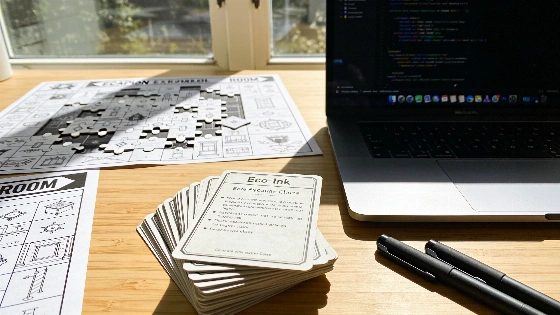
Printable puzzles often run into trouble with color-heavy designs that waste toner or make sheets unreadable on black-and-white copiers. To solve this, each puzzle is made in both a full-color version for digital or inkjet use and a zero-color Eco-Ink edition with sharp dark borders on a white background. Both US Letter and A4 formats are available, so the puzzles work for different printers and regions.
Free Browser Tools for Puzzle Hosts and Teams
For educators, facilitators, and DIY hosts who want to create or manage their own puzzles, four free browser-based tools are ready to use. These tools need no login or email and come with automatic print-friendly styles:
- Printable Escape Room Cipher & Code Maker: Make encoded clues and printable decoder strips for custom secret phrases using Caesar Shift, Atbash Mirror, or A1Z26 ciphers.
- Work-Safe Meeting Icebreaker Generator: Filter and print non-cringe prompts for team-building, remote calls, or multicultural groups.
- Office Copier Paper, Packet & Prep Calculator: Estimate the number of sheets, packets, pens, and copier minutes needed for events of different sizes.
- Printable Party & Team Game Finder + Timeline: Build a minute-by-minute event schedule based on guest count and available time slots.
Anyone building puzzle games or printable digital assets can use the Z3 verification pattern to catch ambiguous clues before players see them. For those interested in more basic Python problem-solving, the loop puzzle guide gives extra practice with logical thinking and code structure.
Tourism drives a large share of escape room demand, with 34.8% of customers being tourists (23.2% national and 11.6% international visitors), which shows why strong and clear clue chains matter for participants who may not know local customs. The escape room industry, described as a leisure sector that "boomed around 2016," keeps gaining from standardized ways to test clues and answer paths, especially as operators create multiple games or printable products for different audiences.