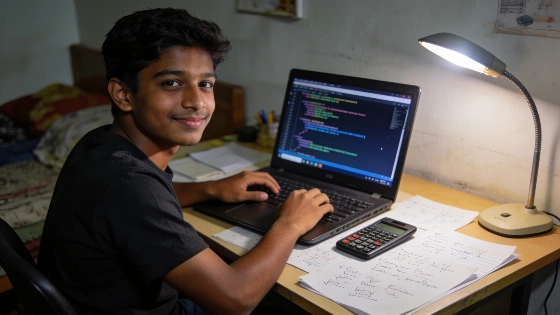
On the nineteenth day of a month-long challenge, a naval architecture student in Bangladesh found himself drawn to a JavaScript tutorial video that promised quick results and interactive web apps. The rules were clear: stick with Python for 30 days, avoid JavaScript completely, and see what happens when all learning effort goes into one language.
Why Language Switching Slows Progress
Many beginners try to pick up several programming languages at once, hoping to expand their skills. In reality, moving between Python and JavaScript can scatter focus and slow down actual progress. For those with limited time to study each day, switching context comes at a steep cost. Each session often begins with a debate—"Which language should I use today? Where did I stop last time?"—and precious minutes slip away before any code appears on the screen.
The 2025 Stack Overflow Developer Survey reports that JavaScript and Python remain among the most widely used programming languages, with 66% of respondents doing extensive development in JavaScript and 57.9% in Python over the past year. Among learners, 71.8% used Python and 62.8% JavaScript. These numbers show both languages are everywhere, but they do not prove that switching between them directly causes a measurable drop in productivity. The real challenge for learners is not the popularity of the languages, but the scattered focus that comes from jumping between them. Stack Overflow Developer Survey 2025
The Relief of Single-Language Focus
In the first week of the challenge, the student felt an unexpected sense of relief. Every Python tutorial seemed useful, and the usual hesitation disappeared. Instead of dividing time between two languages, the full hour went into coding. Small, practical projects—like a script to split a shared mess bill or a set of loop exercises—finally got finished after several failed attempts in earlier months.
Structured learning paths can help manage the complexity of programming education. For instance, a peer-reviewed report from the Federal University of Roraima in Brazil tested a staged approach that separated computational logic from programming syntax. Their 40-hour program, with 64 participants, used visual programming and algorithmic formalization alongside Python, and included peer mentoring to help with the cognitive shift. The report found that 85% of participants felt more technically confident after the workshops, suggesting that gradually separating logic from syntax and focusing on one abstraction level at a time can be a promising teaching method. RECIMA21 scientific journal
The Boring Middle and the Real Test
By the second week, the excitement wore off. Python started to feel repetitive, especially compared to the visual appeal of JavaScript projects seen online. Motivation dropped, and some sessions became shorter and less productive. This "boring middle" is a common stumbling block in any learning commitment, and it is where many challenges quietly stall.
Resisting the Urge to Switch
The turning point came on day 19. After watching a JavaScript app-building video twice, the student opened a blank JavaScript file, then closed it almost immediately. The choice was not about dismissing JavaScript, but about realizing that switching would erase the progress made in Python. This moment of discipline shaped the experiment more than any finished project.
What "Properly" Finishing Looks Like
At the end of the 30 days, "learning one language properly" did not mean knowing every Python feature. It meant finishing projects—something that rarely happened before. Three small but complete Python tools were built: a mess bill splitter, a file renamer for lecture notes, and a quiz script for class review. The file renamer, for example, used a short loop:
for i, file in enumerate(files, start=1):
    os.rename(file, f"lecture-{i:02d}.pdf")
This code steps through a list of files and renames each with a neat two-digit number, making it easier to keep lecture materials organized.
Measuring Real Progress
Over the 30 days, the student coded on 24 days, started no new projects outside Python, and opened a JavaScript file only once—closing it right away. Before the challenge, the pattern was nine unfinished projects split between two languages. Now, for the first time, there was a count of completed work.
Both Python and JavaScript offer structured, official learning paths. Python’s official tutorial, maintained by the Python Software Foundation, gives a guided introduction and reference documentation, making it a stable single-language base for focused learning. Python 3 Documentation JavaScript is also supported by the Mozilla Developer Network’s JavaScript Guide, which covers basics like control flow and error handling, showing that JavaScript learning also follows a systematic curriculum. MDN Web Docs
What This Experiment Actually Shows
This experience does not claim that Python is better than JavaScript for everyone. It shows that constant switching between languages can block real progress, especially for beginners. The main lesson is that finishing projects in one language lays a foundation for future learning, whether the next step is web development or another programming language.
Structured sequencing and steady practice have been shown to help beginners handle complexity. The Federal University of Roraima’s program, which used peer mentoring and a staged move from visual programming to Python, led to 85% of participants reporting more technical confidence. Still, this result measures perceived confidence and does not prove that single-language study is always best. The success of focused learning depends on personal goals, curriculum structure, and the quality of practice.
Applying the Lesson to Your Own Learning
If progress in programming feels slow, try focusing on one language for a set period—like 30 days—and set aside others for now. Track what you finish and pay attention to moments when you want to switch. This method can help you build real coding skills and gain confidence through completed projects.
For more on practical programming strategies and managing several projects, see this related guide on document conversion workflows.