At the Indian Community School (ICS) in southeastern Wisconsin, bringing artificial intelligence into the classroom goes beyond simply providing students with new tools. The school’s method focuses on helping students grasp how AI functions, where it falls short, and how technology choices affect people and the environment. This approach draws from the school’s dedication to Indigenous values and a sense of duty to future generations. It matches the global education framework set by UNESCO, which defines AI literacy as a human-centered skill, highlighting digital and media literacy, informed choices, and attention to impacts on those who come after. UNESCO calls its education framework "based on human rights and fundamental freedoms" (UNESCO, Signals Spotlight 2024).
Starting with Understanding Before Access
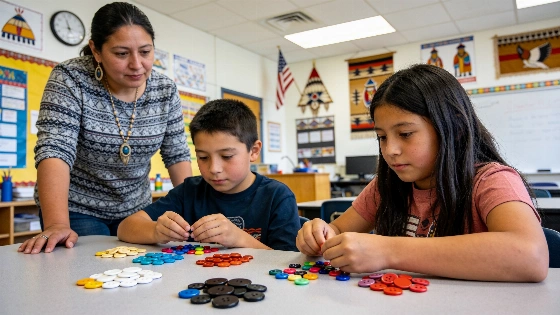
ICS avoids starting with AI-powered devices or software in students’ hands. Instead, even second graders tackle the basics of machine learning through hands-on activities. Sorting buttons by size and color helps children see how AI systems spot patterns and how the quality of training data shapes results. These offline tasks build teamwork and critical thinking, making it clear that AI depends on the data it receives. Students also spot tricky cases—like buttons that don’t fit any group—mirroring the real-world challenges developers face when labeling data for AI training.
The U.S. Institute of Education Sciences' Teachley Data project takes a similar approach for K–5 learners, focusing on students asking questions, gathering and showing data, and checking claims against evidence. The project supports teaching classification, data quality, and evidence review before students use generative or predictive systems. The Institute of Education Sciences explains, "Students will learn through project-based investigations in which they pose questions, collect and represent data, and evaluate claims against the evidence they gather" (IES, Teachley Data).
After students understand these ideas, they start collecting and sorting real data to build simple machine learning models. By middle school, the curriculum covers data sovereignty and privacy, along with the environmental costs of digital infrastructure. This step-by-step process prepares students to judge when and why to use AI tools, not just how to operate them.
Responsible Access and Teacher Guidance
Once foundational lessons are complete, ICS sixth graders can ask to use AI tools for specific learning tasks. Teachers review each request, weighing the purpose and whether using AI fits the assignment—whether for research, writing feedback, idea generation, image creation, or other uses. Access is limited and always guided by teachers, reinforcing responsible use and critical thinking. The aim is to help students decide when AI adds value, when its limits matter, and when their own judgment should take priority.
Responsible classroom AI use calls for teacher preparation and privacy safeguards, as well as bias awareness and human oversight, as the Institute of Education Sciences points out. The IES notes that teachers already use AI and want training, but most have not received enough preparation in AI literacy or privacy. The IES warns that "without strong guidance, teacher use of AI could weaken pedagogy rather than strengthen it." The agency also says AI systems should be built with students with disabilities, families, and special-education teachers as co-designers (IES, Better Together).
Weighing Environmental and Community Impact
At ICS, understanding AI means looking past technical skills. Students are urged to think about the environmental and social costs of technology. The school’s Wisconsin location—where hyperscale data centers are expanding—makes these issues real. Facilities in Mount Pleasant and Port Washington need large amounts of land, energy, and water. Projections show that by 2028, AI-related data centers in the U.S. could use up to 32 billion gallons of water each year.
ICS students dig into why data centers are built in certain places, what resources attract developers, who gains financially, and who faces the environmental costs. They look at whose voices count in decisions, whether Native Nations have a say, and how tribal lands, water, and treaty rights might be affected. These questions show students that technology choices tie directly to community health and environmental care. UNESCO’s education materials stress the need to weigh technology’s effects on society and the environment before students turn to automated tools.
Balancing AI Convenience with Meaningful Learning
ICS stresses that even with strong AI literacy, real learning takes more than quick answers. Students need chances to wrestle with new ideas, make mistakes, and learn from feedback that pushes them. When AI tools give instant solutions, students risk missing the deeper thinking and problem-solving that education aims to build.
In middle school literacy classes, for example, students use a vetted AI tool to get feedback on their writing. They learn to write prompts that ask for feedback on structure and grammar, as well as clarity, tone, or organization. Students are taught to set limits—asking AI for suggestions, not rewrites. This method encourages them to weigh feedback, choose what to change, and keep their own voice. AI is just one source of input; feedback from peers and teachers remains central to learning.
Federal education research is moving toward AI tools with educator controls and privacy protections, along with human-supervised workflows. Projects funded by the Institute of Education Sciences, such as TrueMark, are building browser-based AI writing platforms that let teachers oversee assignments and review students’ writing steps. The TrueMark system uses an AI copilot that asks guiding questions instead of giving answers, while teachers set the rules for AI use. Planned features include rubric-aligned feedback, adaptive help, and a teacher dashboard, showing a governance model where AI access is shaped by teacher-set rules and visibility into student work.
ICS also sees where AI falls short in supporting students. While chatbots may seem patient and encouraging, real learning depends on relationships with teachers and peers who challenge ideas and support growth. The school makes sure AI’s convenience does not replace the human connections that build independent judgment and resilience.
Preparing Students for Responsible AI Use
ICS’s approach to AI literacy is guided by the belief that preparing students for an AI-driven world means more than teaching them to use new tools. It means helping them see what technology can do, what it cannot, and what it might change in themselves and their communities. The school’s framework—rooted in Indigenous values—offers a model for educators who want to balance technology with ethical responsibility and community health.
Across the country, the U.S. Department of Education’s Student Privacy Policy Office states that student information in schools remains protected by federal privacy laws, including FERPA and PPRA. FERPA gives parents the right to access their children’s education records, request corrections, and control the release of personally identifiable information. These rules matter when schools use AI systems that collect student writing, behavioral data, prompts, images, or other identifiable information. The Department has warned that splitting records into unofficial files or treating them as temporary can undermine parental rights, with enforcement actions that may include federal penalties and loss of funding.
Federal education research now focuses on responsible-use issues, including educator controls, privacy, student agency, and transparent writing processes. Projects such as ARIS, an AI-powered intervention system for K–12 mathematics, are being developed to analyze student responses and recommend instructional actions to teachers, highlighting the need for AI literacy that covers what data systems collect and how educators should review automated recommendations.
This article is based on reporting from EdSurge, with support from Learning Commons. The original story is licensed under a CC BY-NC-ND 4.0 license.