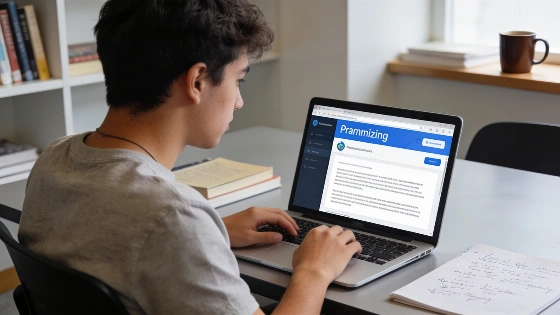
Students looking to sharpen their academic writing often turn to paraphrasing tools. These online platforms use artificial intelligence to rework text, aiming for more concise, fluent, or formal results. For those who find themselves bogged down by wordiness or awkward grammar, a dependable paraphrasing tool can provide real help and fresh ideas. AI paraphrasing tools rewrite user-submitted text to change wording, tone, fluency, or brevity. Industry analysis points out that these tools are not a workaround for hiding AI authorship. As the Rephrase AI Blog puts it, “none of these tools is a way to hide that a draft was written with AI,” drawing a clear line between language support and undisclosed authorship. In academic settings, rewording someone else’s work without proper citation may still count as plagiarism, even if the phrasing changes. Use of these tools falls under each institution’s academic-integrity policies.
What Are Paraphrasing Tools?
A paraphrasing tool, or paraphraser, is an AI-driven app that rewrites text automatically. Users paste their writing into the tool, pick a mode or style, and get a revised version. These tools help improve clarity, adjust tone, or offer alternative phrasing for assignments. Many modern paraphrasing tools now include grammar correction, summarization, and citation support, along with AI suggestions, instead of just basic rewriting.
How Paraphrasing Tools Were Evaluated
To compare the most popular paraphrasing tools, three sample texts were used: one overly wordy, one with grammar mistakes, and one that was disjointed. Each tool’s output was checked for fluency, accuracy, and improvement. Usability factors like word limits, interface design, and change-highlighting were also reviewed. QuillBot and Wordtune, two of the most widely used tools, take different approaches: QuillBot is positioned as a broader document-focused writing suite, while Wordtune centers on alternative rewrites and step-by-step sentence editing, with tone and length controls and browser extensions.
Free vs Premium Paraphrasing Tools
Premium versions of QuillBot and Wordtune delivered the most consistent and accurate results. QuillBot Premium stands out for shortening long passages, its interactive synonym finder, and seven rewriting modes. Wordtune Premium offers a paragraph rewrite feature and generates several paraphrased options for each input, which helps when restructuring awkward or ungrammatical text.
QuillBot’s free tier limits each input to 125 words. Its paid Premium plan removes that cap and adds a monthly plagiarism-check allowance of 25,000 words, plus more rewriting modes. QuillBot Premium is listed at $19.95 per month or $99.95 per year (about $8.33 per month with annual billing), according to the Rephrase AI Blog and The AI Future. Wordtune’s free tier gives 10 rewrites per day, three AI summaries per month, and unlimited grammar checks. The Advanced plan is $13.99 per month or $6.99 per month with annual billing, while the Unlimited plan is $19.99 monthly or $9.99 per month billed annually, as reported by SuperToolDirectory. Paid plans raise or remove rewrite limits, with Advanced allowing 30 daily rewrites and Unlimited removing the cap. Pricing and plan details can change by region and over time, so users should check the vendor’s current pricing page for updates.
Among free tools, QuillBot and Paraphrasing-Tool performed best. QuillBot’s free version keeps high accuracy but restricts users to 125 words per input and lacks advanced modes. Paraphrasing-Tool allows up to 500 words and offers a range of synonym options, making it useful for longer passages. SpinBot and Paraphrase Tool also offer free access, but their results are less reliable. Paraphrase Tool’s summary mode works well, though other modes may not match that quality. QuillBot and Wordtune have different free-tier restrictions: QuillBot limits words per request, while Wordtune limits actions per day or month. This makes direct comparisons between free and premium plans tricky.
Limitations and Usability Considerations
Free versions often cap input length or restrict advanced rewriting modes. Some tools, like Paraphraser.io and Pre Post SEO, were slow, buggy, or prone to errors. Premium upgrades sometimes add little beyond removing word limits or ads. For instance, Rephrase and Paraphraser.io offer paid plans at $20 per month, but their premium features did not show much improvement over the free versions. Pre Post SEO’s premium plan, at $19 per month, also failed to bring meaningful upgrades. QuillBot and Wordtune, as active freemium services, differ in how they handle input or daily-use limits, paid modes, summaries, grammar tools, and plagiarism-related features.
Privacy and data handling matter for students using paraphrasing tools. QuillBot’s privacy policy says collected data, including personal data, may be used to train algorithms, AI models, and AI products. Training opt-out controls are available to account holders but not always to anonymous users, and Premium status does not guarantee stronger privacy. Wordtune’s terms give the service a broad license over user content, and its privacy policy allows personal information and content to be aggregated for AI21 products. Users may need to contact the privacy team to opt out, rather than relying on a built-in control. Students working with unpublished research, client data, or restricted institutional material should check school policy and the vendor’s current terms before using these tools.
Choosing the Right Tool for Academic Writing
Students should weigh their needs when picking a paraphrasing tool. Those needing advanced rewriting or longer text support may find QuillBot Premium or Wordtune Premium worth the investment. For occasional use or shorter assignments, free versions of QuillBot or Paraphrasing-Tool can be helpful. Always check the output for accuracy and make sure the paraphrased text keeps the original meaning and academic integrity. These products are consistently described as writing aids, and their use depends on institutional academic-integrity rules. There is no government enforcement action, court ruling, or formal regulatory decision officially approving QuillBot or Wordtune for academic work. Academic acceptability remains an institutional and assignment-specific issue, especially where disclosure of AI help or citation of source material is required.
For a detailed breakdown of each tool’s strengths and limitations, see the original research at Scribbr. Additional product comparisons and privacy analyses are available from the Rephrase AI Blog.