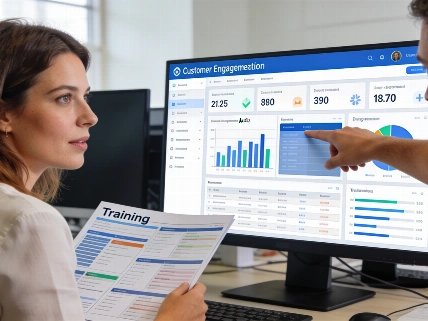
Companies increasingly turn to customer training so users can handle products and services with confidence. When customers know how to apply a product’s features in daily work, they tend to stick with it and see better outcomes. For instance, a business selling accounting software to corporate clients might train users on creating invoices, tracking expenses, managing payments, and generating reports. This helps users work independently and cuts down on errors or support calls. Customer education now stands as a formal business function, with guidance urging that training content align with customer stages like pre-purchase evaluation, implementation, onboarding, and post-implementation expansion. Recommended formats include explainer content, technical demonstrations, implementation checklists, role-based learning paths, advanced courses, certification, and troubleshooting resources (IncreaWorks customer education guidance).
What Is Customer Training?
Customer training is a structured process for teaching customers to use a product or service effectively. Unlike customer service training, which targets employees who interact with clients, customer training centers on the end users. The aim is to help buyers and users grasp product features, benefits, and workflows so they can reach their goals on their own. Guidance separates customer education from internal employee enablement, recommending that organizations assign responsibility for customer-facing learning paths, documentation, webinars, in-product guidance, and certification. This distinction matters because training customers and training staff serve different purposes and use different success metrics.
Key Components and Methods
Strong customer training usually blends hands-on activities with clear learning materials. Companies may use product demonstrations, videos, workshops, self-paced online courses, knowledge base articles, instructor-led sessions, interactive product tours, step-by-step guides, live webinars, and tooltips. These resources fit different learning styles and let customers move at their own pace. Industry guidance repeatedly recommends mixing formats instead of relying on just one training channel, since customers face different learning needs at each product stage and may want either self-paced help or immediate contextual instruction. For example, written guides, short videos, live webinars, interactive courses, and in-product guidance can be matched to specific behaviors or outcomes, such as completing onboarding, using an advanced feature, or cutting repeated support questions.
Benefits for Companies and Users
Well-built customer training programs can drive higher product adoption, greater use of advanced features, lower support costs, and better customer retention. When users know how to install and operate a product, they make fewer mistakes and are less likely to give up on it. Ongoing education also keeps customers up to date on new features and ways to meet their goals. According to figures from iorad, HubSpot Academy generates about 700,000 content leads each year and portals with at least one active Academy certification see a 10–13% increase in customer-dollar retention. Guided onboarding in this context reportedly received a perfect customer-satisfaction score. In addition, a 2026 vendor survey summary cited by BuddyX showed that 76.3% of customer-education programs targeted customer expansion, a 20 percentage point jump from the previous year, and a Skilljar customer case reported an 80% drop in support cases after rolling out customer education. While these numbers come from company reports and may need further verification, they show the possible impact of structured customer education efforts.
Challenges and Solutions
Some organizations see low participation rates, shifting learning needs, or outdated training materials. To tackle these problems, it helps to keep lessons short and interactive, offer recorded and self-paced options, create personalized learning paths, and update resources often. These steps make training more accessible and relevant for busy customers. Guidance also recommends that customer education should address a clearly identified obstacle instead of acting as a generic content library, making sure each resource targets a specific customer need or challenge.
Measuring Success
Measuring customer training effectiveness means tracking module completion, feature usage, assessment scores, product adoption rates, customer satisfaction, support ticket volume, time to value, and retention. However, participation metrics like course completions, webinar attendance, and content downloads show engagement but do not alone prove commercial impact. More telling indicators include changes in onboarding completion, time to first successful use, recurring support questions, product adoption, and customer retention. The recommended approach is to pick one clear customer obstacle, build targeted learning resources, assign ownership, and check if the relevant behavior improves before expanding the program (IncreaWorks guidance).
Anyone interested in building interactive training experiences can find practical approaches to engagement and mastery in the following resource.