Proving that a programming prediction or code forecast was made before the outcome often raises questions for anyone sharing results or tracking learning progress. Without a clear process, others may doubt whether predictions were changed after the fact. Learners, educators, and developers aiming to show integrity in coding experiments or project forecasts can benefit from a reproducible workflow that stands up to scrutiny.
Building a Tamper-Proof Record
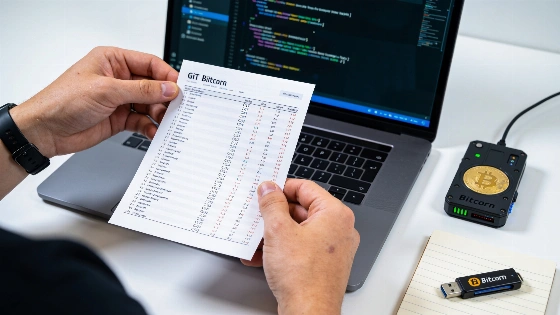
A practical method brings together cryptographic hashing and version control with blockchain-based timestamps. The process begins by saving daily results or predictions in a CSV file before the next event, such as a market open or coding challenge deadline. The file's SHA-256 hash is then logged in a ledger with the publication time, creating a unique fingerprint that changes completely if even one character in the file is altered. SHA-256, defined in the Secure Hash Standard (FIPS 180-4), produces a 256-bit digest shown as exactly 64 lowercase hexadecimal characters. This digest is deterministic: the same input bytes always yield the same output, while any change to the file produces a different digest. Still, hashing does not encrypt the file or reveal its creator or creation time; it only proves consistency between a later-presented file and an earlier recorded digest if the digest record itself has a verifiable time and origin. For educational and coding projects, this lets anyone check the file's integrity at any point in the future using the original hash.
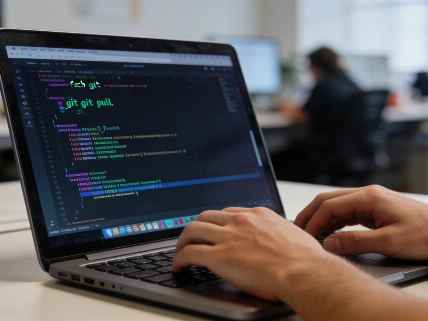
Both the CSV file and the ledger are committed to a Git repository and pushed to a public platform. This step makes the history of changes visible to anyone who has cloned the repository. Any attempt to rewrite history will show up to observers, supporting transparency in programming education or collaborative projects. Git provides an auditable version-control record by storing commits that identify project states and their relationships, but it does not serve as an immutable legal or cryptographic timestamp authority. Git repositories can be rewritten through history-rewriting operations, and hosting platforms can remove or alter repositories. The evidentiary value comes from keeping commit identifiers, public visibility, independent clones, and, where possible, signed commits and external timestamp evidence.
Anchoring Evidence in the Bitcoin Blockchain
For another layer of verification, the file is timestamped using OpenTimestamps, an open protocol that creates decentralized timestamp proofs for digital data. Its workflow hashes a file locally, submits only a cryptographic commitment to public calendar servers, and later upgrades the proof when the commitment is included in a Bitcoin blockchain transaction. The resulting proof is stored in a compact .ots file and can be checked against the original file, so verification requires both the original bytes and the proof. This protocol shows that the committed hash existed no later than the relevant Bitcoin block, but it does not independently prove the author’s identity or that the file was publicly disclosed before the outcome. OpenTimestamps uses calendar servers and aggregation so multiple commitments can be combined before being anchored in a Bitcoin transaction, which reduces the need to publish each file directly on-chain and keeps the timestamp proof small. After anchoring, no trusted third party is needed to verify the proof. The process is free to use, making it accessible for educational and open-source projects. For more details, see the OpenTimestamps documentation.
Practical Considerations for Developers
One technical point to watch is Git's handling of line endings. By default, Git can normalize line endings on checkout, which may change the file's bytes and break the hash verification. To avoid this, a .gitattributes rule should be set to keep files byte-exact, so the SHA-256 fingerprint stays valid across different systems. A file’s cryptographic fingerprint only matters if the byte-level reproducibility procedure is exact. Evidence-preservation guidance recommends hashing the file right after capture, before moving or renaming it, and keeping a manifest. Encoding, line endings, whitespace, filename handling, and file-transfer procedures all matter because a semantically identical CSV can produce a different hash if its bytes differ. The strongest workflow records the hashing command, software environment, file encoding, line-ending convention, and the original artifact along with the digest.
How to Verify a Prediction
Anyone can independently check that a prediction or result file existed before a given outcome. To do this, calculate the SHA-256 hash of the file and compare it with the value in the ledger. Then, use OpenTimestamps to confirm the blockchain timestamp. For example:
sha256sum track_record/scores/2026-10-19.csv # compare with the ledger
ots verify track_record/scores/2026-10-19.csv.ots
The OpenTimestamps workflow uses a compact proof file instead of placing the entire CSV or prediction record on the Bitcoin blockchain. The client first creates a digest, gets a pending timestamp through calendar servers, and later upgrades the proof to include a Bitcoin attestation once anchoring is complete. Verification can be done offline when the verifier has the original file, the .ots proof, and a suitable Bitcoin block source. This distinction matters because a blockchain timestamp authenticates the existence of a cryptographic commitment by a block time, not the contents of the file alone unless the file reproduces the committed hash exactly. The official client procedure for verification is: result = ots.verify(proof, digest, block_source).
Handling Mistakes and Corrections
If an error is found in a published file, the original stays unchanged. Corrections are added as new entries in a public log, never by editing the original file. This approach keeps a transparent and auditable history, which is especially useful in programming education and collaborative development environments. A solid evidence package should keep the original file, its exact hash, the ledger entry, the .ots file, and enough information to let others reproduce verification independently.
Why This Matters for Programming Education
Trust in coding results or predictions relies on evidence, not personal assurances. By using SHA-256 hashes, Git version control, and Bitcoin-based timestamps, learners and educators can build a public, verifiable track record. This method ensures that programming forecasts or experiment results are either validated over time or not, with no way to quietly revise them after outcomes are known. For coding education, forecasting, and open-source experimentation, this workflow can improve reproducibility by separating content integrity from publication claims and by adding an external chronological anchor. Still, it does not stop a participant from preparing multiple undisclosed predictions, selectively publishing favorable records, or misrepresenting what a timestamped file means, so disclosure rules and complete archival practices remain necessary. The method should be described as a technical provenance and integrity procedure, not as universally conclusive legal proof, since admissibility depends on jurisdiction-specific evidence rules and the ability to explain the system’s operation.
This workflow was described by Quantooo Lab, which publishes its track record and educational resources openly at quantooo.com. All formulas, tests, and failures are made public for educational purposes. This guide is for educational use and does not constitute investment advice. For further reading on the SHA-256 standard, see the NIST FIPS 180-4 documentation.