Artificial intelligence now shapes daily routines, and parents across the United States have made their stance clear: they want their children to learn how to use AI tools in school, but only if strong safety measures are in place and teachers are well prepared. A September survey by the National Parents Union (NPU) found that 77% of parents support K-12 public schools teaching students how to use AI tools effectively. Meanwhile, 85% favor instruction on AI safety.
Parental Priorities: Safety and Practical Skills
The NPU survey, which reached 1,528 parents of K-12 public school students, points to a broad call for careful approaches to AI in education. Instead of blanket bans, parents want clear guidelines and solid teacher training. Only 46% of respondents believe their state manages technology use in schools well, highlighting concerns about uneven policies and weak oversight.
Polling reported by the Times Leader showed that 73% of respondents said children already use AI for schoolwork, and 75% supported pausing AI in schools. These numbers reveal a policy challenge: families know AI is already part of students’ academic lives, but want its use to happen under teacher supervision and with privacy safeguards, age limits, and academic-integrity rules (Times Leader).
Even with recent bans on student use of AI in major districts like New York City and Los Angeles, survey data shows most parents want students to build AI literacy. Pam Craig, a mother of three teenagers in Raynham, Massachusetts, said, “I’m not opposed to AI at all. I think it’s a great resource, a great tool. But I’m more concerned about the kids using it solely and not actually learning the information that they’re going to school for, not having some guidelines and guidance on how to use it properly.”
Policy Patchwork and Local Decisions
Without a single federal policy for AI in K-12 education, decisions about classroom use often fall to individual teachers or districts. On July 22, 2025, the U.S. Department of Education issued guidance on how federal grant funds may support responsible AI use in schools, naming three eligible applications: AI-enhanced high-impact tutoring, AI-based instructional materials, and AI-supported college and career advising. This guidance builds on the department’s 2023 report, which recommended keeping "humans in the loop" for important educational decisions and stressed privacy and community involvement. Still, this framework offers funding guidance rather than a nationwide classroom-use policy (U.S. Department of Education guidance).
Districts have responded with a patchwork of local rules. In Los Angeles, the Unified School District has blocked student access to generative AI platforms on district school devices for all grade levels, putting responsibility on the district and educators to decide which digital tools are available (Times Leader). In New York City, a one-year moratorium restricts student-facing generative AI for preschool through eighth grade, while allowing limited use in high school under district conditions. Approved tools such as Quill (for reading comprehension and research) and Edia (for mathematics) are still available in some settings. The policy aims to address concerns about student dependence, academic integrity, age appropriateness, and supervision (Multistate.ai).
Other districts, including Anoka-Hennepin Schools, have set up tiered approaches. Their policy 625.0 sets different AI expectations by grade level: highly restricted exposure for kindergarten through grade five, a structured introduction with guardrails for grades six through eight, and broader access tied to accountability and preparation for further education and work for grades nine through twelve. The policy requires students to use district-approved tools only as directed by teachers, verify and cite AI-generated content, and bans entering personal, nonpublic, or sensitive information into AI systems. Suspected misuse is reported to principals or supervisors, and violations may lead to corrective action under the district’s student-discipline framework (Anoka-Hennepin Schools).
Teachers’ unions and education advocates have called for stronger human oversight and privacy protections, along with age-based limits. The United Federation of Teachers backs the American Federation of Teachers’ 10-point plan, which includes no screens in pre-K through second grade, no student-facing AI in elementary schools, and educator supervision for all other student-facing AI uses, with exceptions for students with special needs. The plan also calls for banning "social companion" chatbots for students under 16 (United Federation of Teachers).
This decentralized landscape means students in different districts may face different rules for generative AI, tutoring systems, research tools, data entry, and citation requirements. Bellwether notes, "New York City Public Schools and Los Angeles Unified School District have set their own policies to limit screen time and AI use in classrooms," which results in uneven access and a policy environment based on tool-specific and age-specific decisions (Bellwether).
Demand for Teacher Training and Proven Tools
Parents care about student safety and want teachers ready to guide responsible AI use. The NPU survey found that 79% of parents support mandatory digital and AI literacy training for all public school teachers. Also, 81% want schools to avoid buying technology that has not been proven safe and effective for learning. Keri Rodrigues, NPU co-founder, stressed the need for proactive education: “We can’t just sit on our hands and say ‘Oh gosh, we’re going to pretend this stuff doesn’t exist.’ The headline for me as a mom, but also what I’m seeing from parents and families in the research, is that we actually want to make sure that we are protecting and preparing kids to be globally competitive for the future.”
Rodrigues also calls for foundational AI literacy before students use AI tools. She says children should understand what AI is, the differences between generative AI and other types, and the risks of using chatbots for companionship before gaining classroom access to these technologies.
Classroom Reality: Gaps in Training and Practice
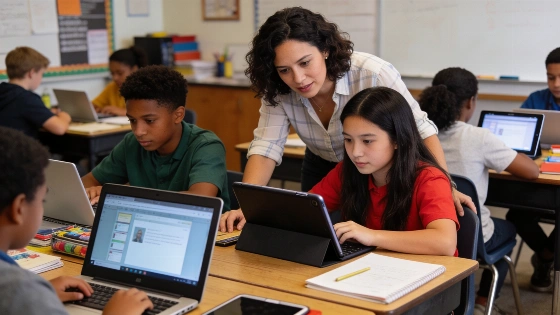
Parents and teachers agree on the need for AI training, but professional development has lagged behind technology. The 2026 “Voices from the Classroom” survey by Educators for Excellence (E4E) found that less than a quarter of teachers reported getting enough training to help students use AI tools effectively, and 43% said they had received no training at all. For their own use, only 37% felt adequately prepared. Evan Stone, E4E’s co-founder and CEO, described the situation as “a brave new world that most teachers are exploring on their own.”
Even with these gaps, many teachers already use AI in their work. Over three-quarters of surveyed teachers reported using AI for tasks such as creating assessments or drafting communications to families, or differentiating instruction, even without clear guidelines.
Balancing Innovation and Safeguards
Parents are not trying to block innovation in the classroom. The NPU survey found that 71% support banning student use of AI chatbots throughout the school day, but they also want students to recognize AI-generated news or images. As Rodrigues put it, “It’s something that requires a scalpel, not a sledgehammer, when we’re regulating it.”
Some AI-powered instructional materials are already in use in schools, often without clear evidence of their effectiveness. The Brookings Institution has warned against framing the debate as a simple choice between banning or fully embracing generative AI, pointing out that this binary approach misses the complexity of the current technological landscape.
As AI becomes more common in education and the workforce, parents and teachers continue to call for schools to provide both the skills and the safeguards students need to use AI responsibly and effectively.