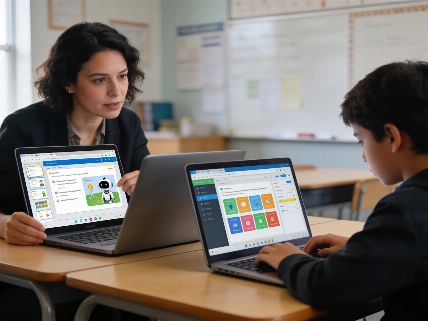
As artificial intelligence becomes a fixture in classrooms, researchers are asking whether students who rely on AI for learning actually build critical thinking and independent judgment that last after the technology is removed. Tina Austin, Project Director of Public Interest Technology Pathways at UCLA and a prominent figure in responsible AI and educational assessment, leads a new international research initiative focused on this question.
Investigating AI's Lasting Educational Effects
The Longitudinal Research Consortium, which launched at the Cambridge AI in Education Summit in October 2026, includes over 40 institutions worldwide. The group aims to find out if AI-supported learning leads to lasting improvements in students’ critical thinking, metacognition, and independent judgment—skills needed for success beyond automated help.
The consortium’s research tracks how students’ abilities change with repeated AI use in different subjects and learning environments. A central focus is what happens when AI support is taken away: do students keep and use the skills they gained, or does depending on AI hold back independent reasoning?
Recent studies show this issue is complicated. In November 2026, a Stanford University team led by economist Rafael Lichand reported that Brazilian middle-school students who used AI for creative assignments lost their performance edge once AI access ended. The study split students into four groups with different levels of AI tool access and had them complete two creative tasks. Results showed that after losing AI support, students’ creative problem-solving dropped below that of peers who never used the tool. Lichand said, "the advantage of the tool was lost," directly questioning claims that AI-assisted performance leads to lasting independent reasoning (Stanford University News).
The Stanford team reviewed over 800 papers on AI in education, narrowing to 20 high-quality causal studies. Their findings separated immediate task performance from transfer—the ability to use a skill alone after support ends. The evidence showed that students who used AI for an initial creative task and then lost access did not keep the tool’s advantage on later tasks, with their performance falling below students who never had AI help.
Other research has looked at how targeted educational interventions can shape students’ reasoning about AI. A 2026 cluster-randomized experiment in Frontiers in Psychology found that a four-week information-ethics course delivered across 16 university classes led to a 0.35-point improvement on a double-rated dilemma test (effect size d=0.71). The biggest gains appeared among students who used generative AI most often, and the intervention improved all measured judgment dimensions. The study concluded that "information ethics education is a workable instrument for strengthening how students judge the ethical use of generative AI" (Frontiers in Psychology).
Additional results from a 2026 study on generative AI use and critical thinking among university students were mixed. Regular AI users had a higher mean critical-thinking score (50.06) than non-regular users (45.42), but Welch’s ANOVA across four AI-use-frequency groups found no statistically significant difference (F(3,24.71)=1.586, p=.218). The authors pointed out that the impact of AI on critical thinking "is not straightforward; it may vary according to how they use AI."
To help assess AI-mediated critical thinking, researchers created the Critical Thinking with AI Scale for Students (CTAI-S), which measures processes like analyzing information, weighing evidence and alternatives, revising judgments, anticipating consequences, and applying prior knowledge. This framework matches UNESCO’s AI Competency Framework for Students and sets a base for future longitudinal studies, though early results rely on self-perceived rather than independently demonstrated reasoning.
Frameworks and Early Findings
Tina Austin’s work shapes the consortium’s approach. Her UnBlooms framework rethinks learning and assessment by focusing on students’ reasoning before, during, and after AI involvement. To measure metacognitive growth, Austin developed the Metacognitive Awareness Scale (MAS), which looks at evidence of students’ thinking processes, including how they check, explain, and revise AI-assisted outputs.
Early results from this research show a move toward more active checking and self-critique among students using AI tools. These findings suggest that, with the right frameworks, AI can prompt learners to engage more deeply with their own reasoning instead of just accepting generated answers.
Still, there are concerns about students relying too much on AI. An article from InterAcademies in November 2026 described a study of 63 middle-school students using ChatGPT for science investigations. Many stopped inquiring without asking follow-up questions and had trouble telling strong prompts from weak ones. The article warned that AI "poses real risks to inquiry-based science education and to the development of students’ critical thinking." It also noted that chatbot design and instructional scaffolding can affect whether AI encourages or replaces student reasoning.
Implications for Educators and Assessment
The consortium’s ongoing studies aim to help educators identify which AI-supported strategies lead to lasting learning. By tracking how students’ skills develop and persist, the research seeks to guide changes in assessment practices and help institutions find effective ways to use AI in teaching and learning.
As AI becomes more common in schoolwork, U.S. teachers have started redesigning classrooms by assigning less take-home work, increasing in-class writing and discussion, and focusing on assignments that measure students’ reasoning instead of just their answers. A 2025 Harvard randomized trial cited by Reuters found that a customized AI tutor improved learning gains and engagement, while a small MIT Media Lab study saw that ChatGPT essay users worked faster but seemed to think less. A 2025 RAND survey reported that more than half of students and teachers in English, mathematics, and science used AI for schoolwork or teaching tasks.
Alongside leading the consortium, Tina Austin heads an Assessment Redesign team within IEEE’s responsible AI in education initiative. Her recent recognition as a LinkedIn Top Voice in AI and education highlights her role in shaping responsible AI adoption in academic settings.
More details about the consortium’s work and participation options are available at research.unblooms.com. Institutions interested in joining or learning more can contact Tina Austin directly at tinaaustin@ucla.edu.