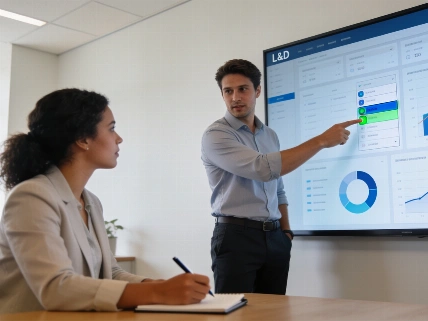

Organizations often dedicate hours to evaluating employee performance, but the impact of these reviews tends to fade quickly after the meeting. The real challenge lies in moving from identifying strengths and weaknesses to building a plan for skill development that fits into daily routines.
Why Performance Reviews Often Fail to Drive Development
Performance reviews and development plans usually run as separate tracks. Reviews might follow a set HR calendar, while development plans get created later, sometimes by different people or in different systems. This split can leave employees without a clear next step. APQC’s 2025 research found that 67% of employees had goals tied to preparing for future roles, yet only 33% strongly agreed their performance management process helped them build needed skills. That gap shows how setting development goals often doesn’t translate into real skill-building support.
Managers often have limited time, learning and development teams may not get access to review data, and there’s confusion about what a connected plan should look like. Without a clear structure, even motivated efforts can stall. Gallup research found only 14% of employees strongly agreed their performance reviews inspired them to improve, showing that standard review meetings rarely spark motivation or real behavior change. Employees who got meaningful feedback in the previous week were much more likely to be engaged, which points to the value of ongoing coaching instead of rare formal reviews.
Gallup’s survey of 18,665 U.S. employees showed that 56% formally reviewed their performance goals with their manager once a year or less. Employees who had quarterly progress checks were 90% more likely to be engaged, making a strong case for structuring a 90-day plan with regular checkpoints instead of waiting for the next annual review.
Building a Practical 90 Day Development Plan
To close the gap between review and real growth, organizations can use a structured approach that turns feedback into steps employees can take. Take Dave, a newly promoted team lead. After his first performance review in the new role, the aim is to help him build leadership skills using a 90 day plan. While this example uses iSpring LMS, the same approach works with other learning management systems.
Step 1: Analyze Review Findings and Gather Evidence
Begin by looking at all available feedback: KPIs, competency assessments, manager notes, and peer input. For leadership roles, 360° feedback is especially useful, since it brings in views from managers, peers, direct reports, and the employee. This method can highlight differences between formal performance results and how leadership behaviors are seen by others. In iSpring LMS, a competency radar shows gaps between self-assessment and others’ feedback, as well as steady strengths or areas to work on.
If Dave rates his communication skills highly but his team reports trouble getting constructive feedback, that points to a development need. Still, it’s important to check team metrics and real workplace examples before making a call. Gallup’s analysis found only 42% of U.S. employees had a chance to formally give feedback to their manager, which shows why upward or multisource feedback matters when assessing new managers.
Step 2: Set Observable Development Goals
Vague goals like "improve communication" are tough to measure. Instead, define what success will look like at the next review. For Dave, this could mean his direct reports regularly say he gives specific, actionable feedback. Setting a target for relevant 360° indicators can help, as long as the rating scale and role requirements fit.
With the Development Plans module in iSpring LMS, Dave and his manager can map out a shared plan for the next 90 days, breaking it into tasks and milestones, assigning a mentor, and setting deadlines. Both can track progress and see what’s left to do.
Step 3: Select Activities That Address the Gap
The right activities depend on what’s causing the skill gap. If Dave knows the theory of constructive feedback but struggles in real situations, a mix of scenario-based training and mentoring or on-the-job training (OJT) can help.
- Scenario-Based Training: Assign interactive courses with realistic feedback conversations and branching role-plays. Dave can practice and learn from mistakes.
- Mentoring: Dave shadows an experienced manager during a feedback session, with chances to ask questions and get feedback.
- On-The-Job Training: Arrange for a supervisor to watch Dave give feedback in a real conversation, focusing on clarity, examples, and next steps.
Step 4: Organize the Plan Into a Realistic Timeline
Building skills takes repeated practice over time. A 90 day cycle can be split into phases:
- Days 1–30: Finish training and observe a mentor.
- Days 31–60: Practice new techniques in real conversations with feedback.
- Days 61–90: Run feedback sessions independently and complete an OJT assessment.
For more complex skills, longer cycles or several back-to-back plans may be needed. In iSpring LMS, each phase can be a separate stage with its own tasks and deadlines. Check-ins can be scheduled as tasks to keep things moving.
Step 5: Evaluate Progress and Adjust as Needed
Finishing activities doesn’t always mean skills have improved. Check progress at three levels: training completion, showing the target behavior, and actual workplace results. iSpring LMS gives reports on course completion, OJT observations, and a Team Development Dashboard for managers. Comparing new 360° feedback with earlier results can show if the gap has closed.
Be careful when reading low competency scores. Sometimes, ratings reflect limited visibility, unclear expectations, or bias rather than a real skill gap. Before assigning more courses, look into what’s behind the score.
Practical Considerations and Next Steps
Development plans are working theories about what will help an employee grow. If progress stalls even after completing assigned activities, it may be time to review the assessment or try a different approach. Linking performance reviews and development plans lets organizations test and adjust their assumptions, instead of starting over each cycle.
Gallup and Workhuman research connects valuable feedback and recognition with better workplace outcomes, including engagement and burnout risk. Employees who strongly agreed they got valuable feedback were five times as likely to be engaged, 57% less likely to report burnout, and 48% less likely to be actively looking for another job. Gallup data also shows that employees who got daily feedback were 3.6 times as likely as those with only annual reviews to strongly agree they were motivated to do outstanding work. These findings support the value of frequent, work-linked feedback conversations within a 90-day development cycle.
For organizations aiming to get more from training investments, this approach fits with strategies for evaluating training budgets, as covered in this earlier breakdown.