Organizations looking to track and improve physical assets and complex systems have turned to digital twins as a key technology. These virtual models mirror the real-world behavior and conditions of objects or processes, letting teams observe and make decisions based on data throughout the asset’s entire lifecycle, from design to decommissioning.
How Digital Twins Work
The main function of a digital twin relies on a two-way data flow between the physical asset and its digital version. Sensors and processors gather real-time details about performance and environmental factors. This information stays in sync with the virtual model, so simulations and analyses always reflect the current state of the real object or system.
The National Institute of Standards and Technology (NIST) describes digital twins as systems that enable monitoring, diagnostics, prediction, and optimization in manufacturing. Unlike static computer-aided-design models, digital twins stay linked to their physical counterparts through operational and sensor data. They depend on synchronization, data quality, and a clear relationship between the physical element and its digital version. NIST points out that interoperability, trustworthy data exchange, and model validation are essential for reliable use.
ISO 23247 defines a manufacturing digital twin as a digital representation of an observable manufacturing element, kept in sync with that element. The ISO 23247 framework divides the system into four functional domains: manufacturing elements, data collection and control, model and synchronization services, and user applications. These domains cover equipment, materials, products, personnel, sensors, simulations, analytics, and decision-support tools. This technical structure helps separate true operational digital twins from isolated 3D visualizations or one-off simulations.
Most digital-twin setups blend equipment hierarchy, design data, operating history, live measurements, degradation models, and simulations. The key is not how realistic the visuals are, but the ongoing link between the physical entity and the digital model for a specific decision. This setup makes digital twins useful in manufacturing, infrastructure, energy, logistics, and other systems where conditions shift over time.
Academic and technical sources stress that digital twins need a steady two-way data flow between the physical system and its digital version. Ongoing updates allow for near-real-time simulation and responses, which matters in industrial settings where equipment states, production rates, environmental factors, and failure risks change constantly. The value of the twin depends on reliable sensing, model synchronization, and the ability to turn outputs into operational steps.
Educational and Practical Applications
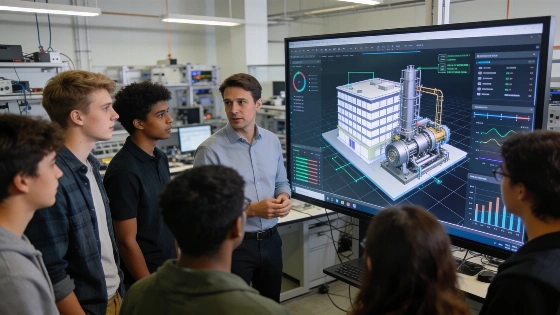
For teachers and students, digital twins give a hands-on way to explore complex systems through interactive simulation and real-world data analysis. Students in engineering, architecture, or environmental science can use digital twins to see how design choices affect performance or to test scenarios that would be tough or expensive to try in real life. In vocational and technical education, digital twins let learners practice with industrial processes in a safe digital setting.
Digital twins help technical education by letting learners inspect industrial processes, test operating changes, and watch system behavior without putting people or equipment at risk. In manufacturing, common uses include virtual commissioning of automation before installation, production-line planning, throughput and bottleneck analysis, operator training, and condition-based maintenance. These uses connect classroom learning with the same monitoring, simulation, and predictive tools used by industrial operators. They fit especially well in engineering, automation, architecture, environmental systems, and vocational training where access to full-scale equipment is limited.
Companies often use digital twins for process optimization, predictive maintenance, supply chain management, and product development. Digital-twin models can monitor an asset’s condition, test operating scenarios before making changes to a live process, estimate remaining life, and plan maintenance. The technical difference from a standard model is the ongoing connection to the physical system and the use of current data for operational decisions.
MarketsandMarkets estimates the global healthcare digital-twin sector was worth about $1.6 billion in 2023, with forecasts reaching $21.1 billion by 2028 and a compound annual growth rate of roughly 67%. Healthcare uses include patient, organ, and hospital twins built from imaging, laboratory, genomic, operational, and device data.
Benefits and Industry Impact
With real-time monitoring and scenario simulation, digital twins help organizations boost efficiency, speed up innovation, and make decisions based on actual data. The technology supports both immediate operational improvements and longer-term planning. NIST reports that digital twin technology in manufacturing covers monitoring, diagnostics, predictions, and optimization.
Setting up digital twins can take significant resources, but the possible gains for education, industry, and research are considerable. The ISO/IEC 30186 standard, released in July 2025, offers a maturity model and guidance for assessing digital-twin capabilities across five aspects and five maturity levels, with Level 5 as the highest. This standard gives a structured way to judge how advanced a digital-twin setup is, instead of treating all implementations as equal.
Technical sources point to interoperability, verification and validation, uncertainty quantification, cybersecurity, and workforce readiness as ongoing challenges for digital-twin use. These issues come up because digital twins often pull data from equipment, enterprise systems, sensors, simulation tools, and control interfaces built to different technical standards. Workforce preparation is treated as a deployment requirement along with software, sensors, and industrial connectivity.
As digital twin technology develops, its use in supporting data-driven learning and operational performance is expected to grow. Frameworks and standards from groups like NIST and ISO will shape how reliably and effectively digital twins are adopted across sectors.