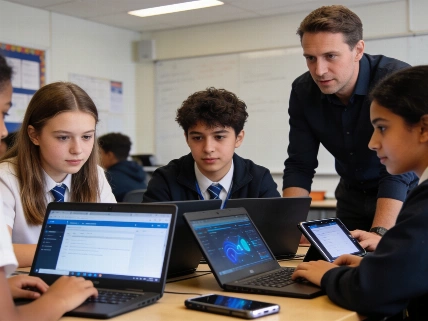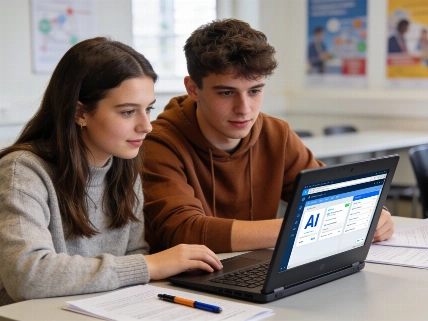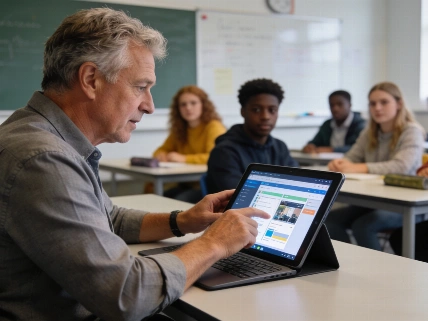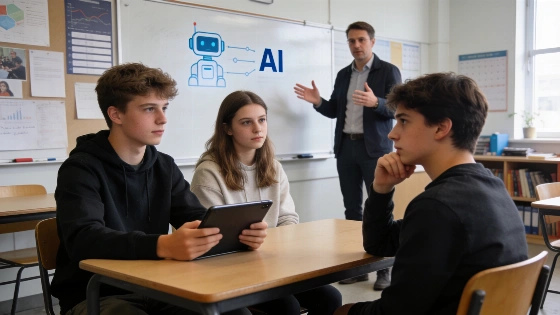
With artificial intelligence shaping much of the information students find online, teachers now face the task of guiding learners to question and analyze what appears on their screens. UNESCO has released a detailed teaching guide to help teachers, curriculum planners, and training institutions handle the realities of AI-driven information. The guide, AI Answers. You Decide. – A Companion Guide to the UNESCO Media and Information Literacy Curriculum, comes from UNESCO’s Institute for Information Technologies in Education and is meant for classrooms and teacher training programs worldwide.
Expanding Media Literacy for the Age of AI
The publication, AI Answers. You Decide. – Teaching Media and Information Literacy in AI-Mediated Information Environments, builds on UNESCO's existing media and information literacy curriculum to address the growing reach of automated systems. The guide includes explanations, discussion prompts, hands-on activities, and examples that teachers can adapt for their own classrooms. UNESCO notes that its main Media and Information Literate Citizens: Think Critically, Click Wisely! curriculum, launched in 2021, has been used in over 40 countries, laying the groundwork for this new AI-focused resource.
Mariya Gabriel, Assistant-Director General for Communication and Information at UNESCO, points to the urgency: "Artificial intelligence is transforming how we learn, communicate and access information. We must, therefore, ensure that people retain the ability to think critically, question what they see and make informed choices." The guide draws connections between AI literacy and media and information literacy (MIL), stressing that students need to evaluate both the content and the ways automated systems generate, rank, and distribute information.
Key Areas and Practical Framework
The guide breaks its content into five connected areas: AI in daily life, AI and the media, AI, the human mind and knowledge, AI, power and human rights, and AI and the future. Each section targets specific learning needs. The knowledge area centers on critical thinking and judging AI-generated information, while the everyday applications section introduces the impact of personal data. The media section looks at changes in journalism and content creation, and the power and human rights area brings up algorithmic bias, inequality, and sustainability for classroom debate. Material focused on the future encourages students to help shape inclusive, human-centered approaches to AI. UNESCO frames classroom AI education as a matter of rights and governance, not just technical skills, by including topics like algorithmic bias, inequality, sustainability, and the wider effects of AI in the "AI, power and human rights" section.
Teachers are urged to use the guide's tools to help students check the reliability and authenticity of AI-generated text, images, audio, and video. The material also sparks discussion about the algorithms and data that decide what information users see, along with the broader impact on knowledge, trust, and behavior. Suggested classroom activities include reviewing AI-generated content, looking at recommendation algorithms, and analyzing how media represents and reports on AI outputs. The guide is built for use in daily teaching through discussions, content-evaluation tasks, and exercises on algorithms and data.
Supporting Critical Thinking and Responsible AI Use
Anne Leppäjärvi, the guide's author, explains, "AI does not change the foundations of media and information literacy, but the environment in which we apply them. The goal is not to keep up with every technological change, but to equip learners with the critical thinking skills to navigate an ever-evolving information environment." The guide examines how core MIL skills, such as critical thinking, source checking, and spotting bias, can be used in information spaces shaped by AI-generated content, recommendation systems, and digital platforms.
The guide was created with input from eight international experts and reviewed by ten more specialists. It complements UNESCO's Media and Information Literate Citizens: Think Critically, Click Wisely! curriculum, which has been tested and adapted in over 40 countries since 2021. According to UNESCO's report on Mongolia’s sixth national Media and Information Literacy Forum, just 26% of citizens using AI-generated information verify it with other sources, a trend especially marked among people aged 18–34. This underlines the need to bring fact-checking, digital safety, platform-algorithm awareness, and AI literacy into formal education, teacher training, and lifelong learning (UNESCO event report).
For teachers looking for more background on why AI literacy matters in schools, a recent analysis discusses how responsible AI education goes beyond simply providing technology. UNESCO has also reported a program to train 18,000 teachers in digital pedagogy and artificial intelligence, aiming to build teachers’ practical digital skills and their ability to use technology and AI responsibly in the classroom. The training covers lesson planning and learning-material development, as well as assessment, while making clear that teachers' empathy and professional judgment remain central to effective learning.
UNESCO's guide gives a flexible structure that can be adapted to different educational settings, helping teachers encourage informed trust, critical questioning, and responsible use of AI-driven information. The guide is available for use by teachers, training centers, and curriculum planners, and aims to help students engage thoughtfully and responsibly with AI as they move through information environments shaped by automated systems.