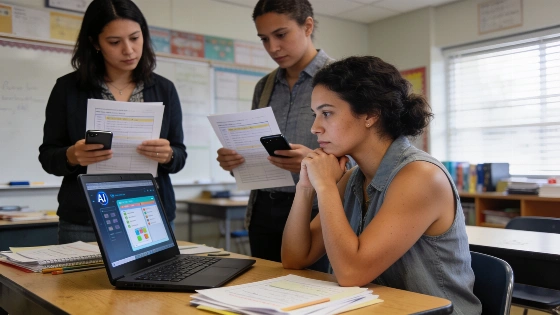
Artificial intelligence is showing up in K–12 classrooms in ways that touch lesson planning and assessment design. Districts have responded with workshops, guidance, and lists of approved AI tools. These steps help educators address privacy and academic integrity, but many teachers still find themselves unsure when it comes to making real classroom decisions involving AI.
The Limits of One-Time AI Training
Attending a single AI workshop gives teachers a starting point with available tools and district expectations. The real test comes later, when educators plan lessons or respond to student needs. Context shapes every move: Will AI help student learning here? Is the generated content reliable? Do all students have fair access? These questions often pop up outside formal training sessions.
Teachers need more than an introduction to AI. They benefit from ongoing chances to experiment and talk through their experiences with colleagues who know their instructional context. This process helps educators build the nuanced judgment needed for responsible AI use in daily work.
Learning from Real Educational Needs
Research from Digital Promise shows that progress in education technology, including AI, works best when research and practice are integrated and when educators collaborate in networks and practice-based settings. Their approach stresses that adopting AI in schools is a process involving design and testing, not a single training event. Their materials state, "We believe real progress happens when research, practice, and technology work as one."
In K–12 settings, teachers often make instructional design decisions on their own. Trusted colleagues become essential when considering how AI might fit into a lesson or assessment. District leaders planning professional learning should see that providing tools and explanations is just a starting point. Teachers gain the most when they can work through real decisions with people who understand both instruction and the local context.
Developing Judgment Through Practice
Building strong instructional judgment around AI takes more than a shared vocabulary or awareness of district policies. Teachers need time to try AI tools, review the results, and adjust as both technology and understanding shift. What works for a high school history project may not fit in an elementary classroom. The right use of AI in lesson planning can differ from how students use it themselves.
Many districts already have instructional coaches, curriculum specialists, and technology integrationists who help educators connect new ideas to classroom practice. In smaller or rural districts, regional service agencies or multi-school educators may fill this role. The job title matters less than making sure teachers have access to experienced colleagues who understand both instruction and AI.
Bringing AI Learning Closer to Classroom Work
Districts do not have to drop workshops or expect every instructional coach to become an AI expert. Instead, they should build flexible AI strategies that shift as technology and educator needs change. The U.S. Institute of Education Sciences (IES) highlighted in its October 2026 publication "Better Together: Advancing Opportunities for AI in Special Education through Collaboration" that teacher preparation is a central issue as AI adoption grows in schools, especially in special education where individualized learning and accessibility matter. The report notes that while many teachers are already using or want to use AI, few have received training covering AI literacy and privacy protections. The IES recommends both pre-service preparation and in-service professional development delivered in the context of teachers’ classrooms and emerging needs, stating, "For in-service teachers, professional development can provide just-in-time training within the context of a teacher’s classroom, as opportunities arise." IES official publication.
Making space for educators to discuss unsuccessful AI uses is also important. Teachers learn from seeing where a tool gave unreliable answers or increased workload. These shared experiences deepen understanding of when AI fits and when other approaches work better. Districts should also look at how they measure professional learning outcomes. More AI use does not always mean teachers feel ready to make informed decisions. Effective measures should focus on educators’ ability to evaluate AI critically and explain their choices.
Supporting Those Who Support Teachers
Instructional coaches and teacher leaders often take on new AI responsibilities without extra time or preparation. Calling someone an “AI champion” does little if they lack chances to build their own expertise. These educators need time to experiment, work with peers, and reach district leaders for policy and curriculum questions. They should also have the authority to raise concerns when a tool does not meet instructional goals. Their main value is in helping teachers assess instructional fit and protect student learning, not in promoting AI just because it is district-approved.
The IES frames AI adoption in special education as a systems-level responsibility, emphasizing inclusive collaboration among researchers, educators, technology developers, and other stakeholders. The institution highlights privacy protections, teacher training, and evidence-based instructional practice as interconnected requirements, and states, "AI will not replace special educators; it should help amplify their expertise." Ongoing training, collaborative design, and classroom-based implementation are prioritized over one-time compliance workshops.
Building Capacity for Real Decisions
As AI keeps changing, teachers will face situations that no workshop could predict. Professional learning must be flexible enough for educators to bring these experiences back to colleagues, learn from them, and apply new insights to future decisions. The IES has supported several projects that show the value of iterative, classroom-based development. For example, the TrueMark project piloted a teacher-controlled AI writing platform with eight teachers and about 350 students in grades 6–8. All participating teachers found the platform intuitive, most reported positive instructional changes, and students’ estimated skills increased across all tracked writing areas, with larger gains among students who completed more assignments. Teachers asked for more accurate AI scoring and greater transparency about how student skill estimates were calculated, leading to further platform refinement and ongoing teacher involvement in development TrueMark project details.
Other IES-supported initiatives, such as Ama Co-Support for inclusive classrooms and VOXPOP 2.0 for historical role-playing simulations, have involved teachers in pilot testing and usability reviews. The Genia project, developing an AI-directed pair-programming platform for high school students, includes teacher usability walkthroughs and think-aloud sessions as part of its design process. These projects show that practical AI adoption in education needs continuing educator participation after initial exposure, with mechanisms for teacher control and usability review addressing challenges of accuracy, transparency, accessibility, privacy, and instructional alignment.
Developing sound judgment about AI use takes practice and reflection with trusted peers. Giving teachers the time and support to build this judgment helps them connect new AI capabilities to the real needs of their students and the core purposes of education.