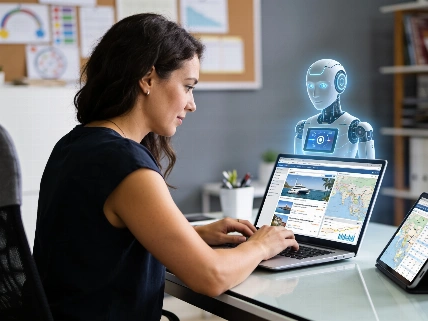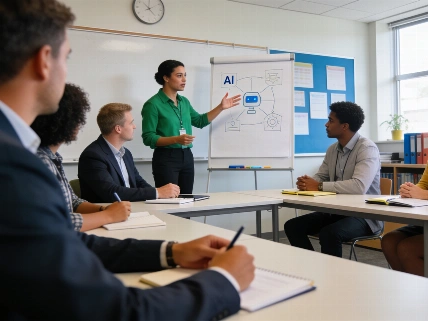
Many organizations face challenges delivering training that matches each employee’s background, role, or skill set. Adaptive learning addresses this by using data to adjust the experience for each person. Employees can focus on what they need to learn and skip what they already know. Adaptive learning covers rule-based pathways and algorithmic systems, as well as machine-learning tools and predictive analytics. It is not limited to artificial intelligence. The main feature is that the system changes the learning experience based on learner performance, instead of following a fixed sequence. This method appears in onboarding, technical training, compliance, product education, and employee upskilling.
What Is Adaptive Learning?
Adaptive learning personalizes training by constantly analyzing what a learner knows and how they perform. Rather than sticking to a set course order, adaptive systems use data from assessments and learner behavior to change the content, order, difficulty, and feedback for each person. This helps organizations create targeted learning paths and avoid repeating material. Research shows adaptive learning is not a single intervention. Its impact depends on the instructional design, content model, learner data, and adaptation rules in place.
How Adaptive Learning Works
An adaptive learning system gathers details about each learner, such as correct and incorrect answers, repeated errors, confidence ratings, time spent, and demonstrated mastery. The system updates its view of the learner’s knowledge and skills, then selects the next activity or resource based on this profile. This creates a feedback loop, so the learning path shifts as the learner moves forward.
Adaptive learning does not always rely on artificial intelligence. Some systems use set rules to guide learners. Others use algorithms or machine learning for more complex choices. The essential point is that the system uses real data to make changes in real time. Evidence separates adaptive systems built to teach from general-purpose AI assistants, which mainly help users finish tasks. Controlled trials show that AI tutors can improve corporate and technical training when tied to specific instructional material and when learners must solve problems before getting answers. General-purpose assistants may help with immediate tasks but do not always lead to lasting skill gains.
Core Components of Adaptive Learning Systems
- Content or domain model: Outlines the knowledge, skills, prerequisites, and learning goals for the subject.
- Learner model: Shows what the system believes the learner knows or still needs to learn.
- Adaptation model: Sets the rules or algorithms that pick the next activity or support.
- Delivery and analytics layer: Delivers the learning experience and tracks progress for learners and administrators.
These parts must work together for adaptive learning to succeed. Weak content structure or unreliable assessments can limit results, even with advanced technology. A review of 30 adaptive training studies found only a small overall effect, with wide variation among adaptive methods. The best results came from adaptive difficulty, followed by adaptive support and test-out options. This highlights the need to evaluate the instructional design and adaptation logic, rather than assuming personalization alone will improve learning (eLearning Industry).
Adaptive vs. Personalized Learning
Personalized learning is a broad approach that adjusts training to fit a person’s goals or experience. Adaptive learning is a specific method that delivers this personalization in real time, using ongoing data to change the learning path as the learner moves forward. Results can differ depending on whether the system adapts difficulty, provides support, lets learners test out, or just automates content delivery.
Benefits of Adaptive Learning
- Relevant learning experiences: Employees address real knowledge and skill gaps, moving forward when they show mastery and getting extra support when needed.
- Faster time to competency: Learners skip material they already know, which helps with onboarding, technical training, compliance, and upskilling.
- Deeper insight into knowledge gaps: Adaptive assessments reveal misunderstandings and skill gaps, helping learning and development teams improve content and target coaching.
- Personalized learning at scale: Technology enables different learning paths for many people. Instructional designers still need to map skills, design assessments, and set adaptation rules.
- Timely feedback: Learners get immediate feedback, such as new explanations or extra practice, while they are still engaged with the material.
Evidence from a cluster-randomized field experiment with 2,574 employees at six county-level power-supply companies in China showed that a knowledge-graph-driven adaptive platform produced small knowledge gains compared to classroom instruction and fixed-sequence e-learning. These gains remained at a follow-up about six weeks later, with reported knowledge decay under 0.10 standard deviations. However, the study noted that the adaptive condition also changed the delivery medium and instructor contact, so the effect could not be linked to adaptivity alone.
Where Adaptive Learning Works Best
Adaptive learning works well when employees start at different points, knowledge can be measured, content can be split into modules, and repeated practice is useful. It is also valuable when time to competency matters and reliable learner data is available. Typical uses include onboarding, compliance, sales and product training, technical upskilling, and education for customers or partners. The approach fits workplace settings where learning is part of daily work, collaboration, and problem-solving, not just formal training. Workplace-learning research points out that organizations that blend learning into daily operations tend to be more resilient and innovative than those relying only on formal training.
Limitations and Challenges
Rolling out adaptive learning takes careful content mapping, reliable assessments, and accurate learner data. Integration with current systems, possible bias in algorithms, data privacy, and ongoing maintenance all matter. Without well-designed parts, adaptive platforms may add complexity without better results. Adaptive systems that personalize content for individuals may not address social learning, tacit knowledge, coaching, or workplace factors that affect performance. Employees also learn through shared practices, collaborative problem-solving, and working with experienced colleagues, so adaptive modules should connect with real tasks and organizational support.
Current evidence does not support treating personalization as always effective. For employers, the practical step is to pilot adaptive systems against fixed-sequence or classroom options, measure delayed retention and job performance, and document which part produced the result. For example, a separate October 2026 randomized trial with 2,379 undergraduate students and 30 instructors at a large U.S. public university found that access to a course-integrated AI tutor was linked to a 0.37-standard-deviation drop in final grades and a 0.90-standard-deviation drop in learning-management-system participation. This result shows the need to separate assistance that completes work from instruction that requires learners to retrieve, explain, and apply knowledge on their own.
Implementing Adaptive Learning: Six Steps
- Identify the performance need.
- Define competencies and mastery criteria.
- Choose a focused pilot program.
- Break content into modules.
- Design adaptation logic based on learner data.
- Evaluate results, refine the approach, and scale as appropriate.
Evaluating Adaptive Learning Technology
When choosing adaptive learning tools, check how well the system matches your instructional goals, whether its decisions are transparent, how easily it fits with your current ecosystem, and if it delivers measurable value. Review which learner signals the system uses, how content is structured, and whether administrators can understand or override automated decisions. Research shows that the design of adaptive learning matters, and outcomes should be measured through unaided tests and retention, not just completion speed or user satisfaction. For more on adaptive learning effectiveness, see this peer-reviewed psychology journal.
Adaptive learning can help organizations deliver more focused and efficient training. Its success depends on clear learning goals, reliable assessments, modular content, responsible data use, and a strategy that puts learning needs first. Strong implementation connects adaptive modules with real tasks and organizational support, recognizing that formal instruction is only one part of building capability in the workplace.