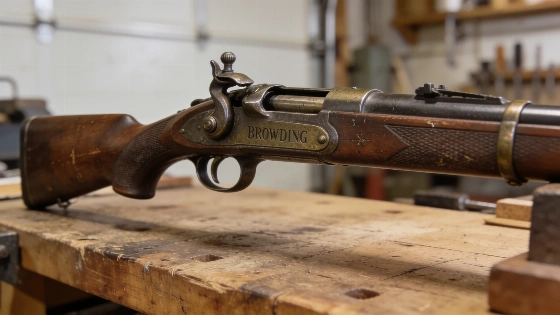
John Moses Browning’s inventive streak changed the firearms industry, introducing mechanisms and models that set the groundwork for modern gun design. In Ogden, Utah, his early work led to the single-shot rifle, which opened the door to a series of technical advances and deals with major manufacturers. Browning’s first big commercial hit was the single-shot rifle that Winchester later sold as the Model 1885. This falling-block rifle, patented in October 1879 as U.S. Patent No. 220,271, marked a turning point. Between 1880 and 1883, Browning and his brothers built about 550 rifles in Ogden before Winchester bought the rights. Winchester then produced roughly 139,725 Model 1885 rifles from 1885 to 1920. The model earned a reputation for its simple, strong action and its ability to handle a wide range of sporting and target cartridges, as detailed by Cimarron Firearms and KY Gun Co. product-history accounts.
Key Patents and Early Developments
Browning’s path started with assembling a slide rifle in 1869, then developing his first single-shot rifle in 1878. He filed the patent for this rifle in 1879, and U.S. Patent No. 220,271 was granted that year. This design was later sold to Winchester, becoming the Winchester Model 1885. Browning kept pushing forward with patents for bolt-action and lever-action repeating rifles and repeating shotguns. The Winchester Model 1887 became the first successful repeating shotgun after its patent was granted in 1886. The Model 1885’s commercial value came from its sturdy action and its ability to be chambered for many cartridges, making it a favorite among sportsmen and target shooters.
Industry Partnerships and Product Expansion
In 1883, T.G. Bennett of Winchester Repeating Arms Company struck a deal with Browning, securing first rights on new repeating designs. This partnership produced iconic models like the Winchester Model 1886 and Model 1894. The Model 1886, based on a Browning design patented in 1884, was built as a large-caliber repeating rifle for hunting big game and became linked to powerful cartridges and African big-game hunting. Production of the Model 1886 ran until 1932, giving it a commercial life of about 46 years. Theodore Roosevelt also favored the Model 1886. The Model 1894, introduced in 1894, was the first American-made repeating rifle designed for smokeless-powder rounds, initially chambered for the .32-40 and .38-55 cartridges, with the .30-30 Winchester cartridge and nickel-steel barrel configuration following in 1895. This model is often called the “ultimate lever-action design” and marked a major shift from black-powder to smokeless sporting cartridges, according to Cimarron Firearms historical accounts (Cimarron Firearms).
Breakthroughs in Semi-Automatic and Automatic Firearms
Browning filed patents for gas-operated and blowback firearms, including the Colt Model 1895 Automatic Machine Gun and the first semi-automatic pistol. His work on autoloading shotguns led to the Auto-5, made by FN and Remington. The Browning Automatic Rifle (B.A.R.) and heavy machine guns further cemented his influence in both civilian and military circles. Browning’s career, which spanned nearly six decades, included the design of several highly influential firearms such as the Colt M1911 pistol and the Browning Auto-5 shotgun. His operating principles—locked-breech and self-loading mechanisms—left a mark on both military and sporting firearms, as noted by Ammoland.
Brand Evolution and Product Line Growth
After John M. Browning died in 1926, the Browning Arms Company kept expanding its product line. The Superposed shotgun, Auto-5 "Sweet Sixteen," and various semi-automatic pistols and rifles were introduced. The company also branched into archery equipment, fishing rods, and outdoor gear. Partnerships with manufacturers like Miroku in Japan and FN in Belgium made it possible to produce new models and revive classic designs under the Browning brand. Modern reproductions of the Model 1885, Model 1886, and Model 1894 remain commercially relevant, keeping the original model names, action concepts, and historically associated chamberings, including .45-70 for the Model 1885 and Model 1886 and .32-40 or .38-55 for Model 1894 variants. These products are marketed as reproductions, reflecting ongoing collector and sporting demand for Browning-era mechanisms (KY Gun Co.).
Corporate Changes and Modern Milestones
Ownership changes saw Browning become part of Fabrique Nationale in 1977, then move under GIAT Industries and later Groupe Herstal. Through these transitions, the company kept a clear line between its military and sporting divisions. The launch of products like the BOSS (Ballistic Optimizing Shooting System), Gold Autoloading shotguns, and the X-Bolt rifle showed ongoing technical progress. The structured commercial relationship between Browning and Winchester, where inventions were transferred or licensed for industrial manufacture, let Browning’s mechanisms reach a national sporting market at production volumes far beyond his family workshop.
Legacy and Continued Innovation
Browning’s legacy includes commemorative editions, new cartridge developments with Winchester, and the adaptation of classic models for today’s shooters. The company’s 125th anniversary in 2003 and John M. Browning’s 150th birthday in 2005 were marked with special product releases and catalog dedications. Browning remains recognized for its foundational role in firearms design and its lasting influence on the industry, with modern replicas and commemorative models continuing to draw collectors and enthusiasts.