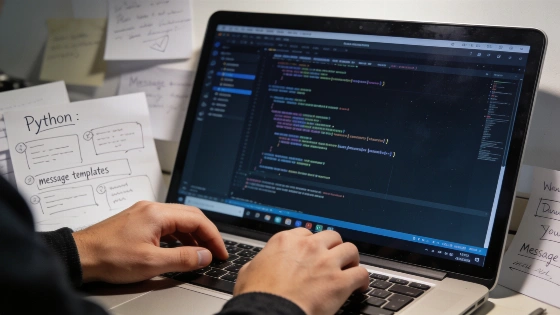
Campaign content management and code reliability often set the tone for the developer experience. In current software projects, teams are tackling these issues by building a reusable message-template editor and focusing on cleaning up Python code while keeping its established behavior unchanged.
Designing a Reusable Template Studio for Outreach Campaigns
Outreach campaigns often need messages that can be customized and previewed across different workflows. Building a unified Template Studio targets the problem of repetitive content creation by introducing reusable content blocks. This setup helps campaign managers organize and preview messages more efficiently within a consistent editing interface.
Early testing has centered on the editor's layout and preview features, along with the controlled creation of reusable message blocks. Yet, integrating these templates into the actual campaign message rendering process remains a sticking point. Displaying content correctly in the editor does not guarantee it will work as intended in a live campaign. Extra safeguards are in place to keep the template editor from bypassing delivery controls elsewhere in the workflow.
For email outreach, following the CAN-SPAM Act is a core requirement. The Federal Trade Commission requires commercial email campaigns to include truthful header information and non-deceptive subject lines. Campaigns must clearly identify advertising content, provide a valid physical postal address, and offer a working opt-out mechanism. Opt-out requests must be honored within 10 business days, and the unsubscribe method must stay active for at least 30 days after sending. Companies are responsible for vendors or senders acting on their behalf, so delivery controls and template-level safeguards are essential in any outreach editor.
Instagram outreach automation falls under Meta's official messaging infrastructure. Automated messaging is allowed only for professional accounts—Business or Creator—and must use the official Instagram Messaging API. Automation tools that ask for an Instagram password or simulate browser activity outside Meta's authorized interfaces are unauthorized and can lead to account restriction or suspension. The platform enforces strict limits: automated replies are allowed only after user interactions such as inbound messages or comments. A 24-hour response window applies to most automated Instagram replies after a user interaction, with a longer window of up to seven days for conversations started through Click-to-Direct ads. There is an operational limit of about 750 comment-triggered replies per hour per Instagram account, and only one private reply is allowed per comment. These rules require the template system to attach delivery metadata—like trigger type, recipient state, and send history—to each rendered message. This ensures that preview success in the editor does not override platform delivery rules. These operational and compliance requirements are detailed in Meta's Messaging API policy documentation and guidance from the Federal Trade Commission.
The next step for this project is to finish integrating the template system, validate the workflow, and get ready for a controlled deployment. This phase will show whether the new editor can reliably support automated outreach on platforms like email and Instagram while meeting all regulatory and platform-specific requirements.
Refactoring Python Code for Consistency and Maintainability
Developer tools that analyze software projects depend on code clarity and maintainability. The ongoing work on Projects Sniffer focuses on simplifying and standardizing the internal Python codebase. The main goal is to make the code easier to understand and maintain while keeping its existing analysis and tracing behavior intact.
The engineering reason for this refactor is maintainability. Standardization cuts cognitive overhead and makes defects easier to spot. It also improves consistency across developer tooling. Python's style guidance, as outlined in Python Enhancement Proposal 8 (PEP 8), stresses readable, consistent code, including naming, layout, imports, and documentation. A behavior-preserving refactor is checked with regression tests, since stylistic changes can still affect edge-case behavior, exception handling, import side effects, or output formatting. Automated tests and checks have confirmed that recent cleanup changes do not alter how the tool interprets or reports code relationships. This process gives confidence that the tool's core functionality remains solid, even as the code structure improves. Remaining tasks include finishing the last formatting updates and running final validation before integrating the changes.
Contrasting Development Approaches
These two projects show different sides of software development. The outreach template editor focuses on building new functionality and fitting it into a larger workflow, while the Python code refactoring centers on maintaining and improving an existing implementation. Both require careful testing and validation to make sure changes support the intended outcomes without causing new issues.
Current Project Status
The combined platform and engineering context points to a staged deployment model for the described tooling: first validate editor layout and reusable content-block behavior, then test rendering through the actual campaign pipeline, and finally enforce delivery controls at dispatch. For email, the production path must preserve unsubscribe functionality, physical-address requirements, truthful headers, and sender accountability. For Instagram, it must verify professional-account eligibility, approved API access, interaction-triggered messaging, and applicable time or rate limits. At this stage, the Template Studio for Socials Sniffer Outreach is still undergoing implementation and controlled testing, with campaign rendering integration yet to be completed. Projects Sniffer has advanced through automated validation of its Python cleanup, but final formatting and checks are still pending. Neither project has reached a production release, and further updates will follow as development and validation continue.