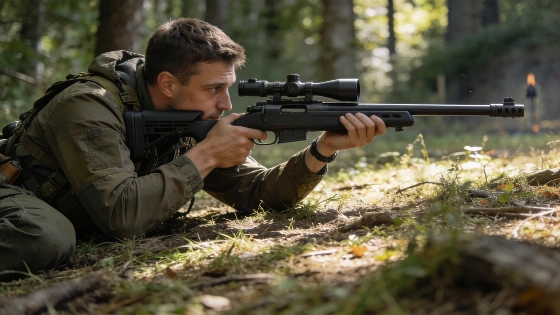
Air rifles today have moved well beyond the basic pellet guns many people recall from their youth. Current models deliver notable accuracy and power, giving small game hunters a real alternative when targeting squirrels. Knowing the technical differences between air rifles helps hunters pick a model that performs reliably in the field.
Key Considerations for Squirrel Hunting
Caliber and velocity matter most when picking an air rifle for squirrels. Product specialists at Air Gun Depot and Pyramid Air recommend a .22-caliber air rifle that can fire pellets at least 800 feet per second (fps). This setup gives enough energy for consistent, humane shots out to 55 yards. These numbers are field recommendations, not legal standards. Air-rifle velocity depends on pellet weight, barrel, power setting, and chronograph setup, so advertised fps figures do not always compare directly between models.
Hunters can use a .17-caliber pellet or a slower .22-caliber, but higher velocity and larger caliber improve reliability. For example, a 14.3-grain .22-caliber pellet at 900 fps produces about 26 foot-pounds of energy. That is much less than a .22LR rimfire cartridge, but it is enough for squirrels with accurate shot placement. No federal rule sets a universal minimum for air rifle caliber or velocity in squirrel hunting. Legality depends on the state, federal refuge, or land-management unit where you hunt.
Understanding Air Rifle Power Plants
Air rifles use different systems to launch pellets. The two main types are pre-charged pneumatic (PCP) and spring-piston (springer) designs. PCP rifles store compressed air in a reservoir, giving multiple shots per fill and usually smoother operation. Springers use a mechanical spring to compress air for each shot. They require manual cocking but offer simplicity and do not need external pumps.
Each system brings its own strengths. PCP rifles often give higher shot counts and adjustable power. Springers are valued for straightforward use and lower maintenance. The best choice depends on your hunting style, budget, and whether you prefer convenience or simplicity.
Comparing Leading Air Rifles for Squirrel Hunting
Some air rifles stand out for small game performance. Here are key models and their main features:
- Benjamin Marauder (PCP): This rifle comes in bolt-action and semi-automatic versions. It can push a 14.3-grain .22-caliber pellet up to 850 fps. Features include an adjustable two-stage trigger, tunable velocity, and a 215cc air reservoir for up to 60 shots per fill. The Marauder is accurate and solidly built, though it is on the heavier side.
- Gamo Swarm Magnum (Springer): This break-barrel rifle fires a 9.7-grain .22-caliber pellet at 1,300 fps and heavier pellets over 900 fps. It comes with a Gamo 3-9x scope and uses a rotary magazine for fast reloading. Cocking takes effort, so it suits adults best.
- Umarex Gauntlet 2 (PCP): With an upgraded air tank and regulator, the Gauntlet 2 gives over 70 shots per fill and higher velocity. Its bolt-action design supports precise shooting, and the rifle offers strong value for its price and performance.
- Diana 350 Magnum Premium (Springer): This German-made rifle features a Monte Carlo beechwood stock, adjustable two-stage trigger, and iron sights with an 11mm scope rail. It is heavier than some rivals but offers classic styling and steady accuracy.
- Air Force Condor SS (PCP): The Condor SS is a high-end choice with adjustable power, a lightweight build, and a top velocity of 1,100 fps. It uses a single-shot bolt action and can deliver 40–50 shots per tank fill.
- Benjamin Trail NP XL (Springer): This break-barrel rifle uses Nitro Piston technology to launch alloy pellets at 1,100 fps and lead pellets at 950 fps. It is heavier and has more recoil but gives solid performance at a lower price.
- Hatsan BullBoss (PCP): This bullpup-style rifle fires .22-caliber pellets at 1,070 fps and uses a 10-pellet rotary magazine with a side lever action. Its compact design helps hunters move through thick woods.
Legal and Regulatory Considerations
Before hunting, check the rules for air rifle use in your area. Federal wildlife regulations do not set a single national standard for air rifles. Instead, legality depends on state law, federal refuge rules, and unit-specific regulations. For example, the Electronic Code of Federal Regulations lists squirrel hunting as allowed on certain national wildlife refuges, but the approved weapons differ by location. In Alabama, refuge rules allow shotguns with No. 4 shot or smaller, rimfire rifles and handguns, or approved archery gear, but do not list air rifles. In Oklahoma, refuge regulations specifically allow shotguns and .22- or .17-caliber rimfire rifles and pistols for rabbit and squirrel hunting (50 CFR § 32.55).
Federal refuge rules show that the same species may be hunted under different rules at different sites. Some refuges allow squirrel hunting from the state opening day until the day before the state archery-deer season opens, and weapon restrictions may apply (50 CFR Part 32 Subpart B). Hunters must check caliber, projectile type, season dates, permits, and public-access boundaries together, not just rely on a rifle’s technical specs.
Federal subsistence rules in Alaska create a separate legal setup. Under 36 CFR § 242.26, subsistence hunters may take all squirrel species and marmots in all Alaska units from July 1 to June 30, with no harvest limits. The rule is still subject to unit-specific restrictions and other bans. Wildlife may be taken by any method unless a rule or another federal law says otherwise, so the exact unit provision is key.
Lands managed by the U.S. Army Corps of Engineers may have stricter rules. Hunting and possession of hunting equipment, including air rifles, are banned unless the district engineer gives written permission (36 CFR § 331.3). Just having an air rifle on Corps-managed land can cause compliance problems even if squirrel hunting is legal elsewhere in the state.
On all federal lands, the main point stays the same: check the controlling regulation, season, property authorization, and allowed weapon type before carrying or firing an air rifle. Official regulatory authorities state, "Seasons are closed unless opened by Federal regulation." Hunters must treat checking jurisdiction as a key part of picking their equipment.
Making an Informed Choice
Picking the right air rifle for squirrel hunting means weighing power, accuracy, weight, and ease of use. PCP rifles usually give more shots per fill and tunable performance. Springers offer simplicity and lower ongoing costs. Think about your hunting environment, physical strength, and budget when comparing options.
The models above are recognized for quality and effectiveness in small game hunting. As air rifle technology advances, hunters have more reliable and capable choices. Always check local hunting rules and regulations before relying on any technical spec or product advice.