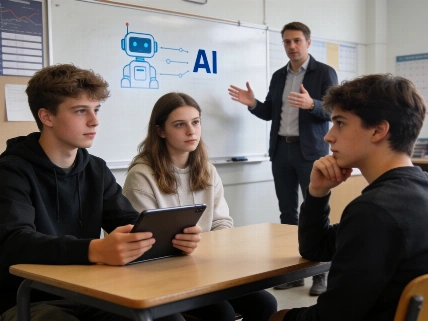
U.S. public school teachers often have English learners in their classrooms, but adapting lessons for multilingual groups still poses difficulties. The National Center for Education Statistics reports that 67.3% of teachers worked with English learners during the 2020–21 school year. Federal guidance stresses that helping multilingual learners goes beyond translation and requires focused academic vocabulary development. Teachers are advised to teach a set of academic vocabulary words intensively over several days, using varied, evidence-based activities (NCES practice guide). New AI-powered projects now aim to support teachers with tools that interpret student discussions and adjust materials for different language needs.
AI Pilots for Multilingual Classrooms
Three teams have secured $350,000 each from Multilingual by Design to create and test AI tools for multilingual education, totaling $1.05 million in funding. The pilots, set for the 2026–27 academic year, will include schools and teachers in Wisconsin, Massachusetts, and Colorado. The initiative began in March 2026 and drew over 180 applications from education nonprofits and AI developers. Selection followed a June 2026 Design Days event in Washington, D.C., where educators, researchers, and AI builders worked with teachers to shape the projects (Multilingual by Design announcement). Each project addresses a specific classroom need, such as analyzing small-group math conversations, preparing accessible instructional materials, or aligning math lessons with students’ English proficiency.
Real-Time Discussion Analysis in Wisconsin
At the University of Wisconsin–Madison, a team is developing Content and Language with AI (CLAI) to give teachers a live look at students’ small-group math discussions. The TRAIL Lab, the Multilingual Learning Research Center, and the WIDA Consortium are building CLAI. The tool combines real-time transcription and translation so teachers can spot students’ use of mathematical concepts and see where support might be needed. This is especially useful when teachers do not speak a student’s first language. The pilot is planned for Wisconsin teachers and aims to help in cases where a teacher does not share a student’s first language. The project description states that CLAI is designed to provide "a tool that gives teachers a live view of small-group math discussions, flagging where students are using key concepts and where they may need support."
Adapting Materials in Massachusetts and Colorado
In Massachusetts, the Joan Ganz Cooney Center at Sesame Workshop and Medley Learning are working on Medley Studio, a tool to adapt existing classroom materials. Planned features include breaking text into shorter sections and adding definitions. The tool will match recommendations to students’ language proficiency. Teachers can review and adjust these supports before sharing materials. The pilot will run in five schools in Taunton. The project is described as "a tool that helps teachers adapt the grade-level materials they already use, adding research-backed scaffolds while keeping instruction rigorous."
DSST Public Schools in Colorado, with Scale Up Partners, will develop Premo, an AI tool to help teachers plan and adapt grade-level math lessons. Premo is meant to align lessons with English language development frameworks and suggest strategies for individual students’ proficiency. DSST will pilot the system across its 16 public middle and high schools in Denver and Aurora, Colorado. The project is part of the 2026–27 pilot cycle and is described as "a tool that helps teachers plan and adapt grade-level math lessons so MLLs can engage with rigorous content while building academic language."
Research and Oversight
Throughline Learning, an education nonprofit in Providence, will provide technical assistance and lead research for all pilots. Teams will use shared measures to evaluate how the tools work for teachers and students, tracking outcomes from classroom discussion to student achievement. ETS is also named as a research partner. Before pilots start, Throughline will help teams define outcomes and data plans. Findings will be developed into case studies and public resources. Each pilot will operate under data-sharing agreements with partner schools, and teams will get coaching to support broader adoption beyond the first sites.
Initiative Background and Support
Multilingual by Design, managed by Social Strategy Associates, launched in March 2026 after an open call that drew over 180 applications from education nonprofits and AI developers. Thirty organizations attended a June workshop in Washington, D.C., where teachers discussed the challenges of supporting multilingual learners. The initiative is backed by the Bezos Family Foundation, Gary Community Ventures, the Gates Foundation, the Hewlett Foundation, the Robertson Foundation, and Sobrato Philanthropies. As the pilots move forward, Multilingual by Design plans to share findings with educators, developers, and funders.
Policy and Responsible AI Considerations
In 2026, a report showed that the U.S. Departments of Education and Justice rescinded or did not enforce earlier federal guidance for English learners, with plans to revisit guidance after the Supreme Court’s 2024 decision in Loper Bright Enterprises v. Raimondo. Legal protections for multilingual learners remain based on Title VI of the Civil Rights Act of 1964 and the Supreme Court’s 1974 decision on educational services for students who do not speak English fluently. Responsible-AI guidance for K–12 education advises schools to involve privacy, legal, security, accessibility, procurement, and academic leaders before using classroom AI. It also calls for testing language quality, cultural representation, disability accessibility, and the risk of inaccurate or harmful outputs. The guidance recommends starting with a small pilot, documenting risks and evaluation steps, training educators, and making sure students keep access to human support.
For more on AI-driven education initiatives, see this reported earlier story on technology grants supporting AI literacy and workforce readiness.