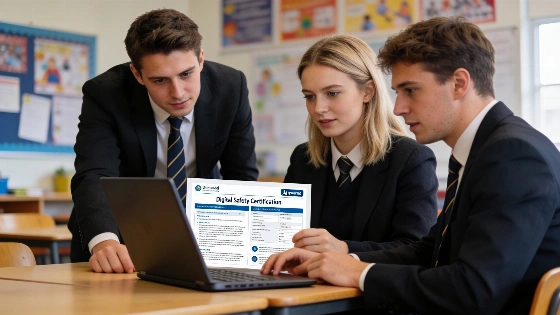
England's Department for Education (DfE) has started a consultation on a certification scheme that would set new expectations for how schools and colleges check the safety of AI-powered and digital learning tools. The scheme aims to help education providers judge whether higher-risk edtech and AI products meet set safety standards. The DfE keeps guidance on digital and technology use in schools, available on the official GOV.UK digital and technology in schools page.
What the Certification Scheme Proposes
The DfE's plan focuses on independent checks for four types of products: filtering systems, technologies that process children's personal data in high-risk ways, student-facing generative AI tools, and personalized learning products for students. Products that pass these checks could show a safety badge and appear on a public register managed by the DfE.
Certification would become the main way to show compliance with safety expectations, but the scheme would not be mandatory at first. Schools, colleges, and early years settings could use other credible evidence to back up their choices if they explain how those measures give the same level of assurance and point out any extra safeguards needed for their intended use.
Scope and Assessment Criteria
The scheme would cover products offered to children in early years, schools, and further education settings in England. Included technologies range from AI tutors and safeguarding systems to platforms for special educational needs and disabilities (SEND) and school management information systems. Lower-risk tools—such as static digital textbooks, hardware, and staff-facing systems that do not process children's data in high-risk ways—are not included. AI agents or custom tools built and used only within a single school would also be left out.
For student-facing generative AI, the DfE lists eight assessment areas: filtering, manipulation, mental health, emotional and social development, cognitive development, governance, design and testing, and monitoring and reporting. Products must show they have steps in place to block harmful content and manipulative or exploitative design.
Implementation and Oversight
The DfE wants to own the scheme and license its delivery to third-party organizations, with independent conformity assessment bodies (CABs) making certification decisions. The United Kingdom Accreditation Service (UKAS) would check if these CABs are competent and impartial. Certification fees would be set by assessment bodies, and the consultation asks suppliers what annual costs they could handle before passing them on to customers. Support for smaller suppliers could include templates, self-assessment tools, technical help, reduced fees, or more preparation time.
Expectations for using certified products would be set through statutory guidance, including Keeping Children Safe in Education and the Early Years Foundation Stage framework. Ofsted and other inspection bodies could look at how leaders make decisions about technology and safeguarding, focusing on institutional culture and the effects on children rather than blaming schools for failures outside their control.
Risks Addressed by the Scheme
The DfE points to three main risk areas: unlawful or inappropriate use of children's data, exposure to harmful content, and possible effects on cognitive, social, and emotional development or mental health. The scheme would check if products have protections against these risks, but it would not act as a general endorsement of teaching quality or learning outcomes.
Consultation and Next Steps
The consultation is open to education providers, suppliers, assessment organizations, safeguarding specialists, parents, and students. It asks for feedback on the scheme's scope, assessment criteria, costs, and how it would work. The DfE does not currently have powers to require certification, so the consultation also asks if future legislation should make certification mandatory in some cases.
Technical, vocational, and applied learning are given as examples where using a non-certified product could be justified, especially when older students need experience with workplace technologies and suitable safety protections are in place. For more on how responsible AI education is being shaped in schools, see this related analysis.