Across the United States, teachers say that handling student behavior ranks among their toughest job pressures. The U.S. Department of Education points to classroom behavior, absenteeism, parental involvement, and special-education services as issues teachers raise in discussions and roundtables nationwide. Educators often note that disruptive behavior sometimes goes unchecked and that consequences vary, which cuts into learning time for the whole class. The Department states that "every child deserves a safe, orderly classroom," and sees classroom management as key to protecting instructional time and giving all students a fair shot at learning in a supportive setting (U.S. Department of Education).
What Is Classroom Management?
Classroom management covers expectations, routines, relationships, teaching methods, and behavior supports that shape a safe, predictable, and productive learning space. This approach uses proactive steps to head off problems and steady responses to challenges, always with respect for students and a focus on keeping learning time intact. The American Psychological Association points out that students pick up how to behave and interact with others, so teachers should teach expected behaviors as directly as academic content. Strong classroom management means setting high expectations, building positive relationships, and giving all students the support they need.
Why Classroom Management Matters
Clear classroom management keeps learning time on track, cuts down on uncertainty, and boosts participation. When students know what is expected and how the classroom runs, they can pay closer attention to learning. The Department of Education says that when disruptive conduct is ignored and consequences shift, "learning suffers for everyone." A well-planned approach can save time lost to unclear directions or transitions, make participation more predictable, create a welcoming space, and help teachers respond steadily to challenges. It also flags when teaching changes or extra support might be needed.
Key Elements of a Classroom Management Plan
A classroom management plan is a written guide that spells out how learning will be organized, how expectations will be taught, and how teachers will respond when students need extra support. A solid plan usually includes:
- Purpose: A description of the classroom environment teachers want, such as students feeling comfortable asking questions and knowing where to get help.
- Expectations: Two to five positive, observable expectations (for example, "Be prepared" or "Use technology responsibly") with clear explanations for different situations.
- Routines and Procedures: Documented steps for entering and leaving the room, getting materials, asking for help, moving between activities, joining group work, using devices, submitting work, and responding to attention signals. These routines should match school-wide policies.
- Instructional Engagement: Plans for making lessons clear, challenging, accessible, and interactive, including movement, choices, and regular checks for understanding.
- Feedback and Acknowledgment: Ways to recognize students who meet expectations and give feedback that helps learning.
- Response Process: Steps for reminders, redirection, reteaching, consequences, restorative conversations, family contact, and specialist support, with fairness and consistency.
- Review Cycle: A process for reviewing data and feedback to adjust routines, policies, or strategies as needed.
Ten Evidence-Based Classroom Management Strategies
Research shows that the most effective classroom management strategies work together as a system. Fixing unclear instructions or lessons that students can't access matters as much as responding to behavior. These strategies have research backing:
- Set a small number of clear expectations.
- Teach routines as deliberately as academic content.
- Design engaging and accessible instruction.
- Use active supervision.
- Provide specific feedback.
- Manage noise and transitions intentionally.
- Correct behavior calmly and privately.
- Use behavior data to identify patterns.
- Build relationships and culturally responsive norms.
- Match support to the level of need.
Adapting Management for Different Contexts
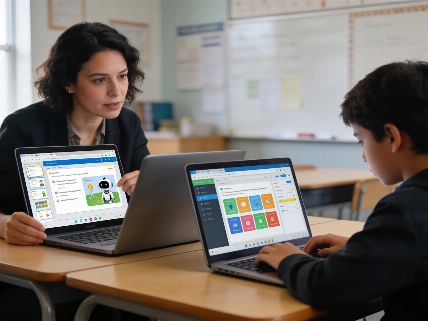
Classroom management needs to adjust for grade level, subject, class size, and delivery method. The Department of Education notes that some students need extra behavioral support and that classroom policies should balance individual student needs with every student’s right to a safe, orderly environment. Educational technology can help by displaying agendas, running assessments, organizing assignments, communicating with families, managing devices, and tracking participation. Still, technology should make classroom management easier, not more complicated.
Measuring Success in Classroom Management
Signs of effective classroom management include how quickly lessons start, the quality of transitions, on-task participation, how often disruptions happen, student views on clarity and safety, behavior referrals, teacher confidence, and steady routines. These measures aim to improve classroom environments, not to penalize teachers or students. The Department of Education places classroom management within broader school-support systems, alongside absenteeism, parental involvement, and special-education services, and stresses that it goes beyond teacher technique alone.
Integrating Management into the Learning System
Classroom management works best as part of a unified system that connects expectations, lesson design, relationships, routines, behavioral support, professional development, and organizational capacity. The Department of Education treats classroom behavior as a state and local policy responsibility, stating that "states and local communities must develop policies that balance individual student needs with the right of every child to learn." Teachers and school leaders are urged to address ongoing challenges thoughtfully, rather than simply adding more rules, and to make sure all students benefit from a safe, orderly classroom environment (Department of Education guidance).