Stanford University has assembled a team from neuroscience, psychology, engineering, and computer science to build AI models that predict human brain responses during various activities and conditions. The Stanford Digital Brain Project, a five-year initiative launched on November 2, 2026, by the Wu Tsai Neurosciences Institute, aims to generate large datasets of human brain activity and use them to train foundation models that forecast neural system responses to experiences, conditions, and interventions. The project relies on the intersection of modern machine-learning techniques and advances in noninvasive neuroimaging, which now allow for brain activity measurement at higher spatial and temporal resolution. Faculty from the Wu Tsai Neurosciences Institute, Stanford’s School of Humanities and Sciences, School of Medicine, and School of Engineering are involved. The project remains in early development, with participant recruitment pending Institutional Review Board approval (Stanford Daily report).
Building AI Models with Brain Data
The research program draws on Stanford’s imaging equipment, shared labs, and AI computing resources. Model development will use Marlowe, a GPU computing cluster identified by the Stanford Institute for Human-Centered Artificial Intelligence (HAI), to support AI training. Daniel Yamins, Associate Professor of Psychology and Computer Science and Faculty Scholar at the Wu Tsai Neurosciences Institute, has been central to the project’s direction. Yamins says that training foundation models on large-scale brain data could let researchers make quantitative predictions about how brain circuits process information, opening new ways to test hypotheses about brain function in digital settings. He describes the models as computational tools for hypothesis testing and for simulating interventions before clinical trials, rather than as full replicas of individual minds. Yamins asks, "Let’s say you wanted to change the brain state to go from a diseased to a healthy state. Where do you perturb so that will happen?"
Advanced Imaging and Wearable Technology
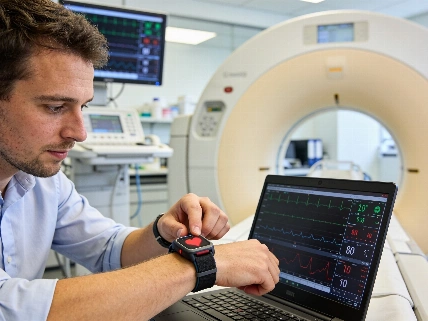
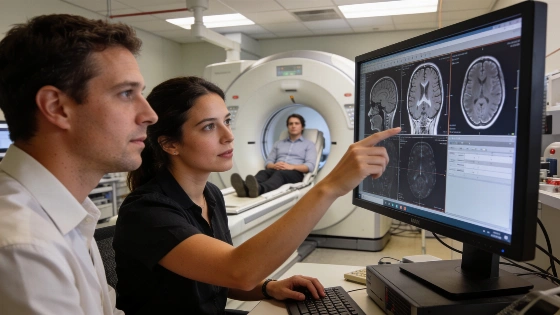
Researchers will gather complementary measurements using an ultra-high-field 7-tesla functional MRI (fMRI) scanner at the Lucas Center for Imaging at Stanford Medicine and a wearable optically pumped magnetometer magnetoencephalography (OPM-MEG) brain-imaging system at the Koret Human Neurosciences Community Laboratory. The 7T fMRI system is set up to provide detailed spatial measurements of brain activity. The OPM-MEG detects tiny magnetic fields linked to neuronal electrical activity and captures timing information at millisecond-scale resolution. Laura Gwilliams, Assistant Professor of Psychology at Stanford, leads the OPM-MEG work. The helmet-based OPM-MEG system measures faint magnetic fields produced outside the head by electrical currents in neurons. In these studies, participants will view, describe, and recollect thousands of videos, giving researchers a way to examine how brain networks coordinate perception, attention, and memory. This approach is intended to create datasets for computational model training and to capture how different brain networks interact during daily activities.
Staged Model Development and Research Goals
The model development team will use computational methods developed by Yamins and colleagues to train foundation models on the combined datasets. The first stage will focus on modeling individual brain systems, such as perception and memory, before moving toward models of the entire human brain. Data collection and model development will inform each other throughout the project. Researchers will compare model predictions to measured brain activity and behavior to check accuracy and guide further work. The scientific goal is functional prediction: estimating how brain activity changes in response to stimuli or altered conditions, rather than proving that an artificial model uses the same internal mechanisms as the biological brain. Yamins has pointed out that better prediction of brain activity does not mean an AI system is internally organized like a brain, stating, "A model that predicts brain activity better is not necessarily more brain-like internally." Prototype applications for understanding and intervening in brain disease are also part of the research goals, but these remain experimental and need more testing.
Potential Impact on Brain Disorders and Open Access
Researchers expect these models to help identify subtle changes in brain networks linked to disorders like depression and Parkinson’s disease. Possible uses include finding early biomarkers and developing more targeted interventions that could be tested in clinical studies. The project also considers using models to investigate why individuals respond differently to treatments. Kang Shen, Director of the Wu Tsai Neurosciences Institute, points to longer-term possibilities such as simulating proposed brain-circuit interventions before patient testing or running virtual experiments to develop theories about networks involved in autism or Alzheimer’s disease. The project is structured to let researchers explore these questions computationally, with predictions checked against brain measurements and human behavior. Independent neuroscience commentary has noted that models that accurately predict brain responses could eventually stand in for animals or people in tests of new stimuli and treatments (The Transmitter), but also stresses that high predictive accuracy alone does not show that the model captures all causal mechanisms of human cognition or pathology.
Data Sharing and Collaboration
Stanford plans to make the resulting datasets and models freely available to researchers worldwide as part of an open-science effort. The data-sharing approach will build on existing Stanford-developed resources, including the OpenNeuro platform and the Brain Imaging Data Structure used to organize brain-imaging data. While the intention is to accelerate research and collaboration across the neuroscience and AI communities, the reporting does not specify licensing terms, release dates, privacy safeguards, or whether all raw participant data will be public. The project’s practical impact is presently prospective, as recruitment remains contingent on Institutional Review Board approval.
For readers interested in broader questions about AI’s role in educational research, a recent report examined how AI acceleration is affecting research progress and highlighted both the potential and uncertainty of AI-assisted model development.
The Stanford Digital Brain Project receives lead support from philanthropists Mark and Mary Stevens, with additional support from Clara Wu Tsai. The project is also part of a broader institutional strategy, with the Wu Tsai Neurosciences Institute and the Institute for Human-Centered Artificial Intelligence funding additional joint AI-and-neuroscience grants to support research at the intersection of brain science and artificial intelligence.